
Feminist Film Festival Explores Women’s Voices Across Generations
An eclectic selection of films spanning decades and regions of India has been brought together under the banner of “Just a Story: A Festival of Feminist Films”, an academic initiative by the Anveshi Research Centre. The festival revisits enduring questions about women’s autonomy, domestic power structures and the layered realities of gender across class and culture.
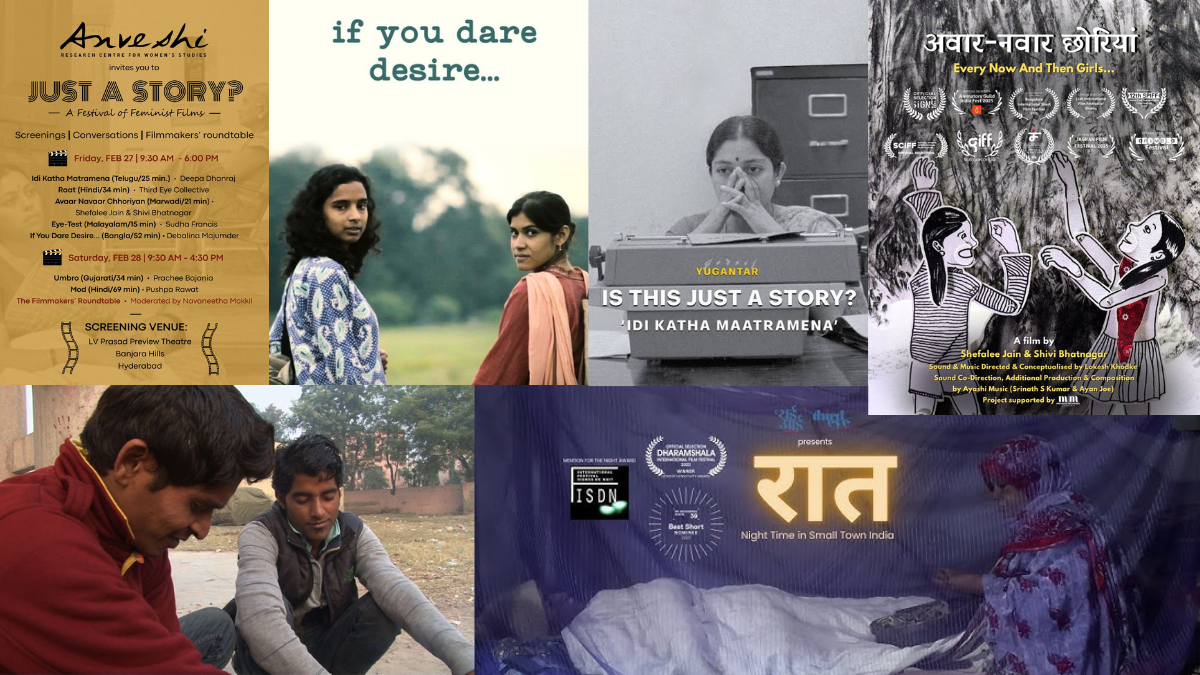
The line-up includes Idi Katha Maatramena, If You Dare to Desire, Avaar Navaar Chhoriyan, Raat, Umbro and Mod. Some of these films date back to the 1980s, yet their themes remain strikingly contemporary. Idi Katha Maatramena by Deepa Dhanraj, available on Yugantar.film website, brought to light that her work is still so much similar to the recent year’s The Great Indian Kitchen, which have reignited conversations around domestic labour and patriarchal hierarchies within households. Director Deepa Dhanraj expressed concerns that there hasn’t been much change since her movie came in 1983. The curators articulated decades ago, women’s lives shaped by male authority and in-law expectations, continue to echo today.
The documentary Raat, from the directors of The Third Eye, offers one of the most innovative entries in the programme. It chronicles the night-time experiences of young women from diverse regions of India, who record their lives in vlog-style narratives framed through a cinematic lens. The anthology weaves together these individual accounts, revealing how fear, aspiration, freedom and restriction intersect after dark. By situating night as both a physical and symbolic space, Raat connects women from varied walks of life, illustrating shared vulnerabilities alongside distinct personal circumstances.
Equally compelling is If You Dare to Desire, by Debalina Majumder, based on the real-life story of a lesbian couple from Bengal. While the film adopts a fictionalised turn towards its conclusion, the real story ended tragically, with both women losing their lives. The filmmaker, Majumder, has spoken publicly about her own experiences of hostility, including attacks from conservative sections of society angered by her portrayal of same-sex love. Her reflections form a poignant backdrop to the screening, underlining the risks faced by artists who challenge entrenched norms.
In a more experimental vein, Avaar Navaar Chhoriyan, by Shefalee Jain and Shivi Bhatnagar, presents an anthology of girls’ stories narrated through unusual witnesses, a tree trunk, a bird and other elements of the natural world. The film incorporates fragments of illustrated books, brought to life through dynamic camera movements. By allowing animals and inanimate objects to “speak”, the work offers a fresh perspective on girlhood, innocence and violence, suggesting that even silent observers bear testimony to injustice.
Collectively, the films reveal how women’s voices, though shaped by different economic and cultural contexts, have articulated similar struggles for centuries. Yet the festival avoids presenting feminism as a monolithic demand for uniform equality. Instead, it echoes a long-standing principle within feminist thought: the movement is concerned as much with equity as with equality. Women begin their journeys from unequal starting points; acknowledging those disparities is essential to genuine empowerment.
The organisers at Anveshi emphasise that simply invoking equality in the abstract will not deliver meaningful change. Development, they argue, requires recognising the diverse realities from which women set out, whether rural or urban, affluent or marginalised, and addressing the structural barriers unique to each.
By revisiting older films alongside contemporary works, “Just a Story” underscores storytelling itself as an act of resistance and remembrance. For every generation, giving space to such narratives remains both an artistic endeavour and a social imperative.