
Hyderabad, April 3- Indian Art Festival at Jubilee Hills, Hyderabad, begins April 3, continuing through 4th and 5th, showcasing diverse contemporary artists and creative expressions.
A quiet hum of colour, texture, and thought took over the city as art lovers streamed into the Jubilee Convention Centre, where imagination unfolded across canvases and sculpted forms.
Featuring 30 galleries, 300 artists, 3000 artworks, and 80 booths, the Indian Art Festival expands scale and ambition. Director Rajendra Patil, seasoned cultural curator and visionary leader, says, “Art connects, questions, and evolves with every viewer.” across Hyderabad this week.
The recent art festival at the venue brought together a compelling mix of emerging and established voices, each negotiating identity, memory, and material in distinct ways.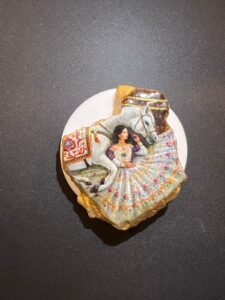
The showcase reflected a wider shift in contemporary Indian art, where personal narratives meet technique-driven experimentation. “Art today is not just to be seen, but to be felt and questioned,” noted the festival’s founder, underscoring the immersive nature of the exhibition.
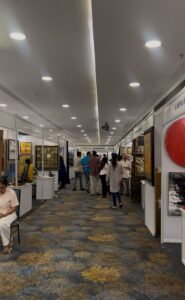
Across the festival floor, Indian artists translated inner worlds into tangible forms, each work carrying a rhythm, a story, and a silence waiting to be interpreted.
- Amrish Malvankar
Where Structure Meets Stillness
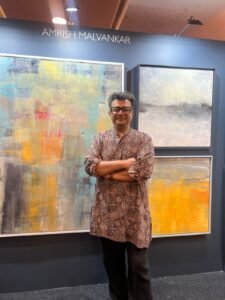
Artist Amrish Malvankar and Mahesh M. Karambele’s works formed a compelling dialogue within the exhibition, where structured abstraction met expressive visual storytelling, each offering distinct yet harmonious perspectives on form, depth, and contemporary artistic thought.
Amrish Malvankar’s works stood as meditative anchors within the exhibition. With an architectural sensibility drawn from his training at Sir J.J. School of Architecture, his canvases explored balance and spatial rhythm. His Mindscape (Serenity & Syntax) series revealed a duality, quiet introspection paired with structured cadence. Through layered textures and restrained tones punctuated by intensity, his paintings invited viewers into slow contemplation. His palette leaned toward muted hues, allowing subtle transitions to emerge organically, while his compositions reflected a deep engagement with emotional geometry and internal landscapes.
- Anita Raj
Echoes of Rajasthan’s Windows
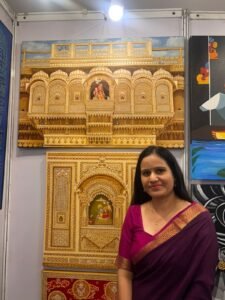
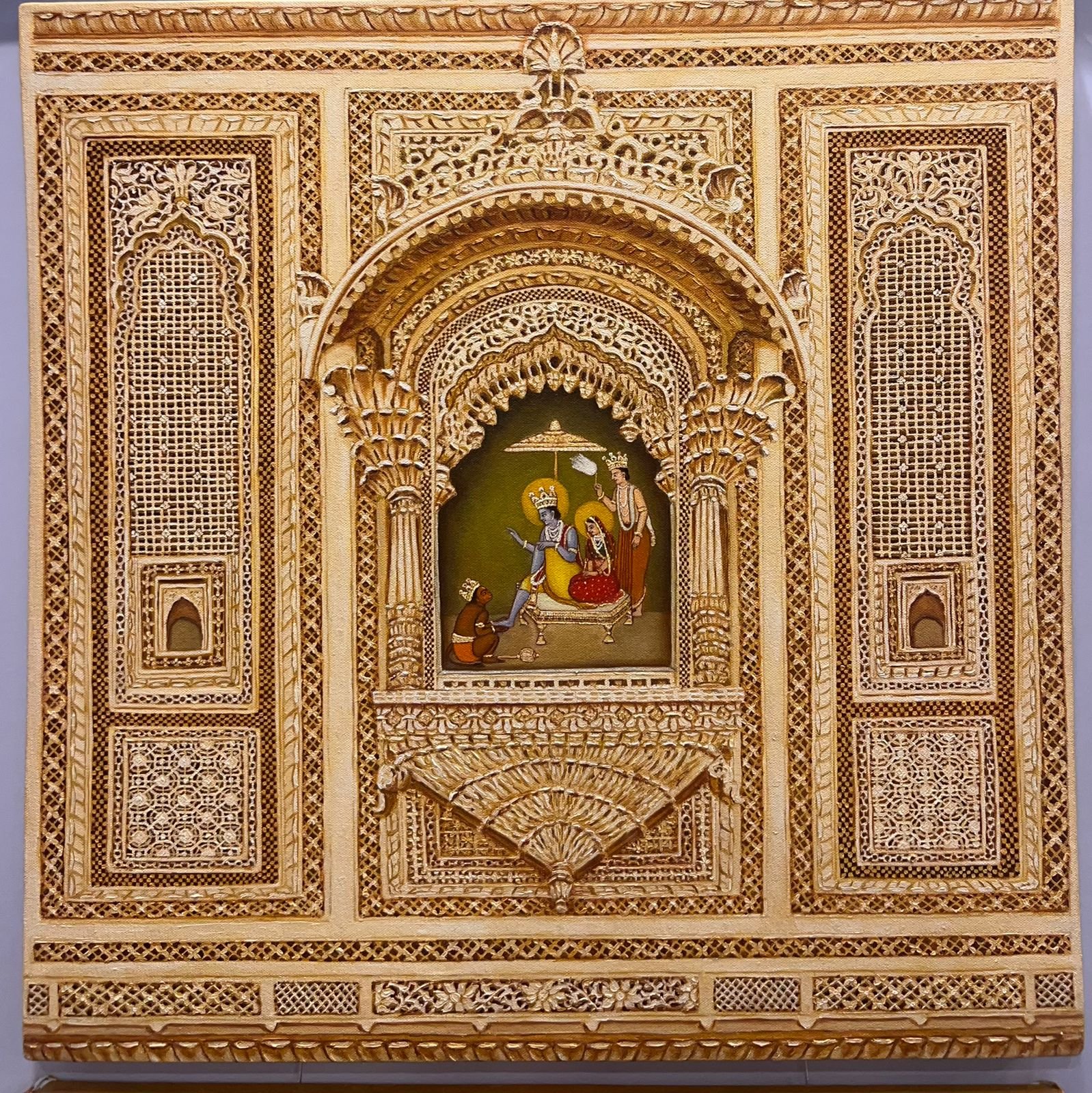
A self-taught artist from Rajasthan, Anita Raj’s canvases carried the nostalgia of havelis through intricate windows and textured surfaces. Her oil works captured architectural memory, while her Buddha-inspired piece reflected spiritual philosophy, weaving visual storytelling with sacred verse in a quietly evocative manner.
- Gayathri
Geometry in Devotion and Identity
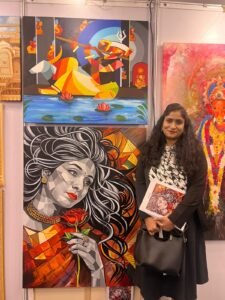
Hyderabad-based Gayathri brought a vibrant interplay of form and faith. Her cubic interpretations of Ashtaganapati reimagined divinity through geometry, while her striking female portraits—rendered in greys with voluminous hair, explored identity, strength, and personal inspiration with compelling visual contrast.
- Lakshmi Korasala
Notes of Blue and Silent Music
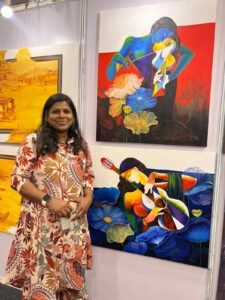
Lakshmi Korasala’s practice blended discipline and curiosity. A teacher at CHIREC, she gravitated toward musical instruments as visual subjects, placing them against stark white backgrounds. Her dominant blues created emotional resonance, while her explorations of lotus leaf patterns and thread work added layered depth and rhythmic visual movement.
- Art Sudha
Carving Heritage in Ceramic Layers
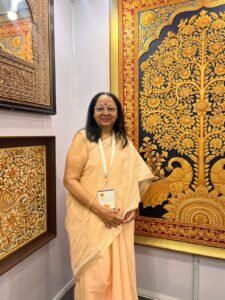
From Noida, Art Sudha’s works stood out for their painstaking ceramic detailing. Each piece, taking months to complete, featured intricate carvings of parrots, foliage, and ornamental patterns. The mirror-like finish enhanced their richness, evoking a sense of heritage preserved through tactile, layered craftsmanship.
- Sama Kantha Reddy
Faces of a Living Society
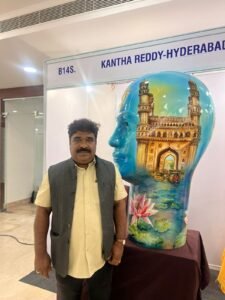
Sama Kantha Reddy’s sculpted heads offered a profound study of human complexity. Drawing from rural and urban narratives, his works captured layered emotions and societal reflections. Award-winning and deeply expressive, his sculptures transcended form, becoming living embodiments of contemporary human experience.
- Prashantt Yampure
Kathakali Reimagined, Hanuman Reborn
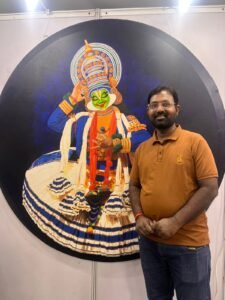
Prashantt Yampure’s work drew from the theatrical intensity of Kerala’s Kathakali, reinterpreting it through a contemporary lens. His composition of Hanuman, embodied as a Kathakali dancer, fused mythology with performance grammar. The vivid facial detailing, dramatic expression, and layered costume language translated devotion into a striking visual narrative, balancing tradition with inventive storytelling.
In a city constantly in motion, the festival carved out a rare pause, where art was not just observed but absorbed, questioned, and quietly carried forward by those who encountered it.
By Vaishnavi
For more such content please check, http://www.fridaywall.com