

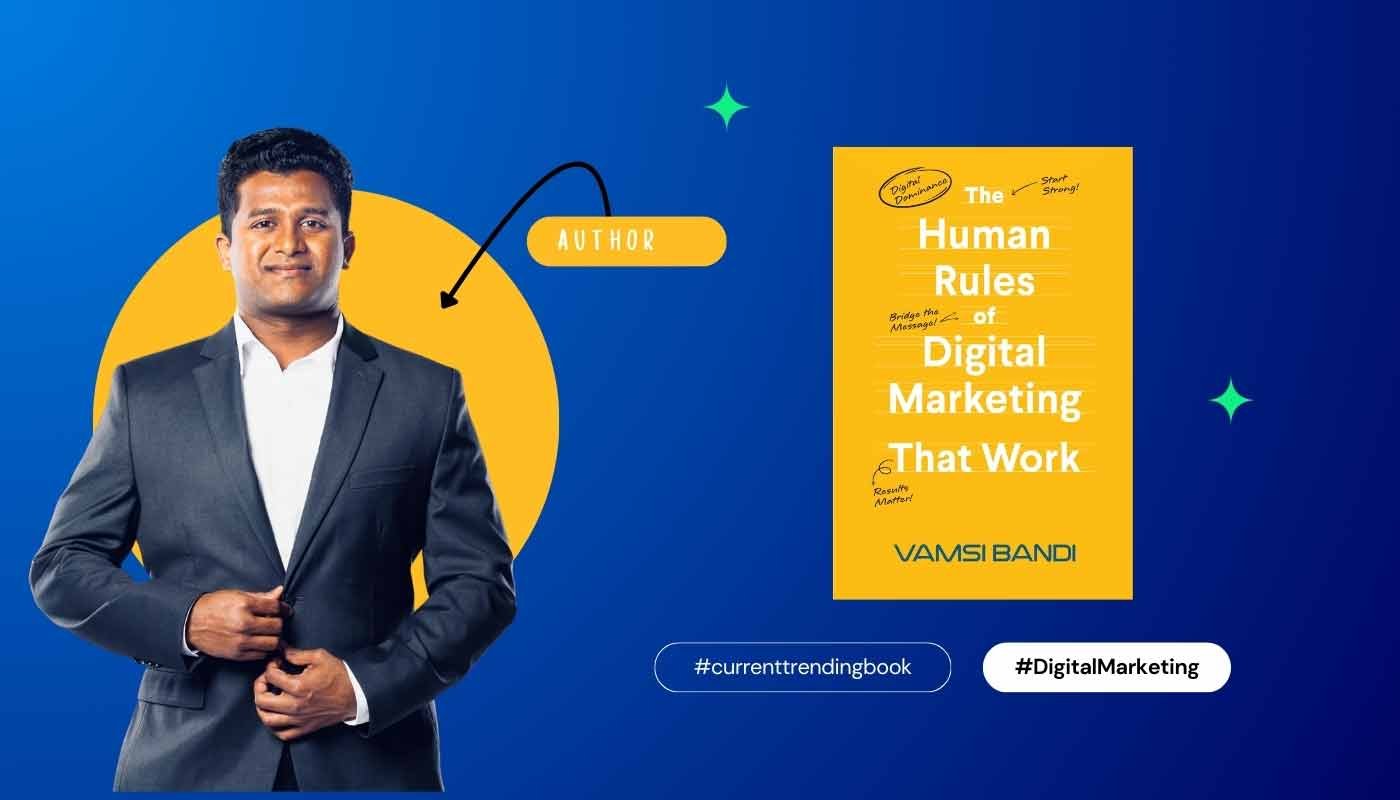
In The Human Rules of Digital Marketing That Work, Vamsi Bandi reframes success, shifting the focus from clicks and conversions to clarity and credibility
By: Team Fridaywall
Vamsi Bandi’s new book arrives with a question that feels uncomfortable: why, in an age of hyper-targeted ads and endless content, are people trusting brands less? In his debut book, ‘The Human Rules of Digital Marketing That Work‘, Vamsi doesn’t offer a quick fix. Instead, he demolishes the myth that more data automatically leads to better marketing. The book argues that while marketing activity has intensified, trust and engagement have steadily declined, not because tools are inadequate, but because the thinking has drifted away from human behaviour. “If your audience is human, why aren’t you marketing like it?” he asks.
Human Decision Moments
Vamsi perceives digital marketing not as a collection of platforms or hacks, but as a series of “human decision moments,” where timing, intent, and credibility matter more than scale. In a space dominated by dashboard overviews and performance metrics, his insistence on trust as a primary metric feels less like nostalgia and more like a necessary reset. The idea that marketing must return to people sits at the centre of his professional journey as well.
Tracing The Blind Spots
An Indian-American author and digital marketing strategist, Vamsi has spent over a decade working with businesses to build scalable marketing systems, often at the intersection of technology and psychology. “MY work has been shaped by watching campaigns that looked efficient on paper, but failed to connect in reality. This gap occurs due to a lack of understanding of how people actually make decisions,” he adds.
With a Master’s degree in Information Technology Management from Rivier University in the United States, Vamsi’s book draws from psychology. “The questions I ask myself are: why people click, what drives curiosity, and how trust is built or broken in digital environments?,” he says. He firmly believes that human behaviour remains constant even in a rapidly changing ecosystem.
The book doesn’t reject data-driven marketing; instead, it questions its blind spots. He points to message overload, poor timing and excessive optimization as factors that erode credibility, even as brands increase output. “Success is not measured by clicks alone but by whether communication aligns with what a user actually needs in that moment,” he adds.
“The industry is at a point where automation can generate content, predict behaviour and optimize campaigns, but the outcomes don’t always translate into stronger relationships with audiences,” he argues. “What’s missing is intention,” he adds.
Persuasion At The Core
The Human Rules of Digital Marketing That Work is structured as a set of guidelines that help marketers identify where persuasion breaks down. These include aligning communication with buyer intent, understanding the difference between push and pull engagement, and evaluating clarity as a performance metric. “It’s less about prescribing tactics and more about recalibrating thinking,” adds the Indian author living in the US.
What makes his trajectory interesting is that it doesn’t follow the typical arc of a marketing expert building authority through scale or visibility. Instead, it is built around questioning the system from within — understanding its tools, but also its limitations.
Trust is “the real currency” of digital success, says the book. The difference is that today, trust is harder to earn and easier to lose, especially in an environment saturated with content and driven by algorithms. The book suggests that the future of marketing may not belong to those who can reach the most people, but to those who can remain believable and retain credibility.
Here’s an Excerpt from the Book
The Human Rules of Digital Marketing That Work by Vamsi Bandi
Publisher: California Book Publishers
Developing Your Digital Marketing Strategy
Aligning Marketing with Business Objectives
The Balloon That Floated Sideways
A boutique toy company outside Copenhagen once launched a biodegradable helium balloon with a flower seed inside. The idea was poetic and sustainable: release the balloon and, weeks later, a flower would bloom somewhere below.
The marketing was impeccable. Visually striking ads, thoughtful copy from an international agency, and eco-friendly packaging. The team tracked impressions, clicks, and shares. On the surface, the launch looked successful.
Sales, however, barely moved.
In a post-launch meeting, the founder asked a simple but uncomfortable question:
“How did this campaign help us reach our three-year goal of expanding into Germany?”
No one had an answer.
The campaign had created attention, but not direction. Like the balloon itself, the marketing floated beautifully, just not where the business needed it to go.
Marketing Without Alignment Is Just Noise
In strategy, power without direction is wasted force. Military leaders and chess masters understand this instinctively. Marketing is no different.
Many campaigns begin with excitement around tactics: starting a podcast, going viral on social media, experimenting with AI-generated content. What’s often missing is the pause to ask how these efforts actually support the company’s long-term goals.
True strategic marketing does not begin with trends. It begins with clarity: clarity about the business mission, the outcomes that matter, and how marketing can influence them.
What Alignment Actually Means
At its core, alignment connects three critical layers:
- Business Objectives
What the company is trying to achieve, such as revenue growth, market expansion, retention, or profitability.
- Marketing Strategy
The role marketing plays in achieving those objectives includes positioning, audience focus, and value creation.
- Tactical Execution
The specific actions, campaigns, content, and channels used to deliver the strategy.
Most marketers operate almost entirely in the third layer. When the first layer is ignored or assumed, campaigns lose relevance and impact.
The Alignment Gap in Practice
Research consistently shows a disconnect between intent and execution in marketing alignment.
- Many leaders believe their marketing metrics connect to business growth.
- Far fewer can clearly demonstrate how marketing directly contributes to ROI.
This gap explains why well-executed campaigns still underperform. Without alignment, success is measured by activity rather than outcomes.
Common Misalignments and Their Cost
Misalignment shows up in familiar ways across industries:
- Startups invest heavily in brand awareness while failing to capture leads, burning capital without building a pipeline.
- B2B companies chase website traffic and clicks instead of conversions, mistaking volume for growth.
- Small businesses celebrate rising follower counts while customer churn quietly increases.
These situations are not failures of creativity. They are failures of purpose.
The Three Filters of Aligned Marketing
Before approving any campaign or tactic, apply these three filters:
- Will this move a core business metric?
Focus on outcomes such as revenue, retention, expansion, or cost efficiency, not surface-level engagement.
- Does it reflect real customer behaviour or intent?
Base decisions on what customers already need and do, not what the brand hopes they will do.
- Can its contribution be measured?
If measurement isn’t possible, explicitly treat the initiative as an experiment or learning investment.
If a tactic fails even one filter, it deserves reconsideration.
The Psychology Behind Alignment
Behavioural science shows that people trust systems that feel coherent and intentional. Alignment creates that coherence.
Externally, customers respond more confidently to brands whose messaging and actions feel purposeful. Internally, teams perform better when marketing is clearly tied to business priorities. Leadership, in turn, is more likely to invest in marketing that demonstrates strategic value rather than surface-level activity.
Closing Insight
Every marketing action sends a signal. Some build momentum. Others create a distraction.
Alignment ensures that every signal reinforces the same direction, strengthening its impact over time. Misalignment, no matter how creative or well-produced, only adds noise.
A single, well-aligned email that drives meaningful action is worth far more than a thousand viral likes that lead nowhere.
Key Takeaways
- Alignment links business objectives, marketing strategy, and execution.
- Misaligned marketing may move metrics, but not the business.
- Effective marketers translate goals into campaigns with clear, measurable impact.
- Meaningful marketing is not louder. It is more intentional.
The book is available to buy at