
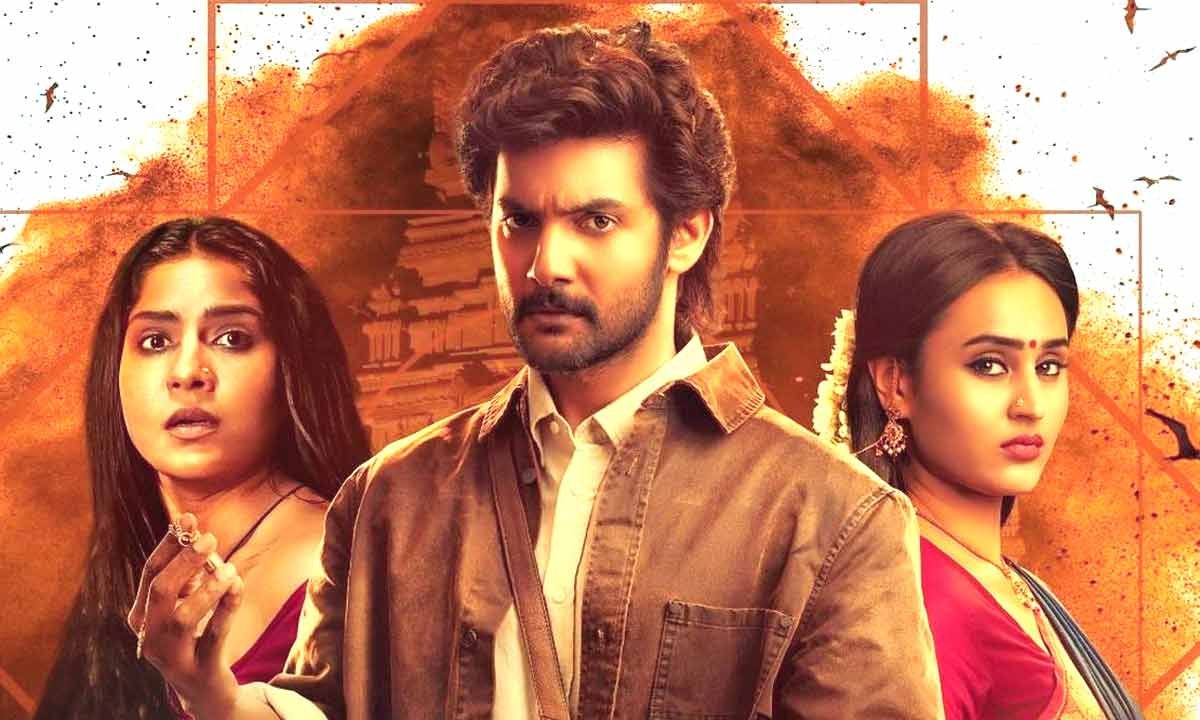
Shambhala starring Aadi Sai kumar, is a story that draws from mythology and part imagination, and works well in parts.
Shambhala in Sanskrit means a place of peace, and some ancient texts refer to it as a hidden place in the Himalayas which is prophesied to be the birthplace of Kalki — a reference also made in an earlier film by the same name.
The latest movie starring Aadi Saikumar is a story that draws from mythology and part imagination, and is set in a quaint village called Shambhala.
The village gets its name from a yogini who is inhabited by a powerful demon and agrees to be buried alive in a cave in order to save the villagers from being killed by an evil force that enters her body. As she does this so that peace may prevail, the village worships her as its deity.
The origin of this dark evil force is intelligently drawn from an existing story in Hindu texts about the Vastu Purusha. According to Vedic texts, during a cosmic battle, a drop of Shiva’s sweat created a giant being whose growing power threatened the universe. Brahma named him Vastu Purusha, and the gods pinned him to the Earth with his head to the northeast and feet to the southwest. His bound form became the Vastu Purusha Mandala, the sacred blueprint of space inhabited by various deities.
The writers of ‘Shambhala’ take a step forward and speak about yet another drop of sweat from the demon in the war, which goes on to become a powerful negative force feeding upon the vanity of human beings. Like a virus, it attacks people with negative thoughts and leaves their bodies only after killing them.
Going back to the yogini (the narrative of the film too goes back and forth trying to explain to the audience the story arc, backstory, and current context), the 1,000-year-old story becomes relevant when a meteoroid strikes the village and sets in motion a series of deaths and strange occurrences.
As the villagers start facing one death after another and blame the space rock for it, a geologist and scientist from the city, Vikram, comes to test the rock. He is an atheist and believes only in science. Interestingly, the rest of his teammates, who are also men of science, are shown wearing visible symbols of faith. How that contributes to the context of the film is food for thought.
Coming back to the rest of the story — the Telugu movie ‘Shambhala’, released during the Christmas weekend with a lot of scope for increased viewership, has at its core an engaging context, and the trailer carried with it a promise of thrill.
‘Shambhala’ starts off well. One of its lapses is that the filmmaker dwells too much on individual episodes, leaving the film as a stitched tapestry of various scenes — some of them stretched beyond necessity. The bright side is that several actors get a chance to display their histrionic skills.
The manner in which these episodes are woven together in order for the film to reach a not-so-logical end leaves a lot to be desired in terms of the finer aspects of filmmaking.
On the face of it, ‘Shambhala’ carries with it enough thrilling moments, suspense-filled scenes, and surprises to give it a decent, if not amazing, run at the box office. The climax banks too much on emotion but fails to build up the momentum.
What works for the film is Aadi, a good actor who delivers on what is given to him. The female leads, Archana Iyer and Swasika Iyer, are not expected to do much. Ravi Varma gets a good role, which he performs well. Sri Charan Pakala’s music is a plus for the film.
‘Shambhala’, directed by Ugandhar Muni, sets an intriguing context to begin with, but ends up as rhetoric minus emotion. The film is designed to be a win of good over evil and of the power of faith to win over the most darkest of forces. However, it struggles with too many threads that fail to come together for an effective end.
Review by Rajeshwari Kalyanam