

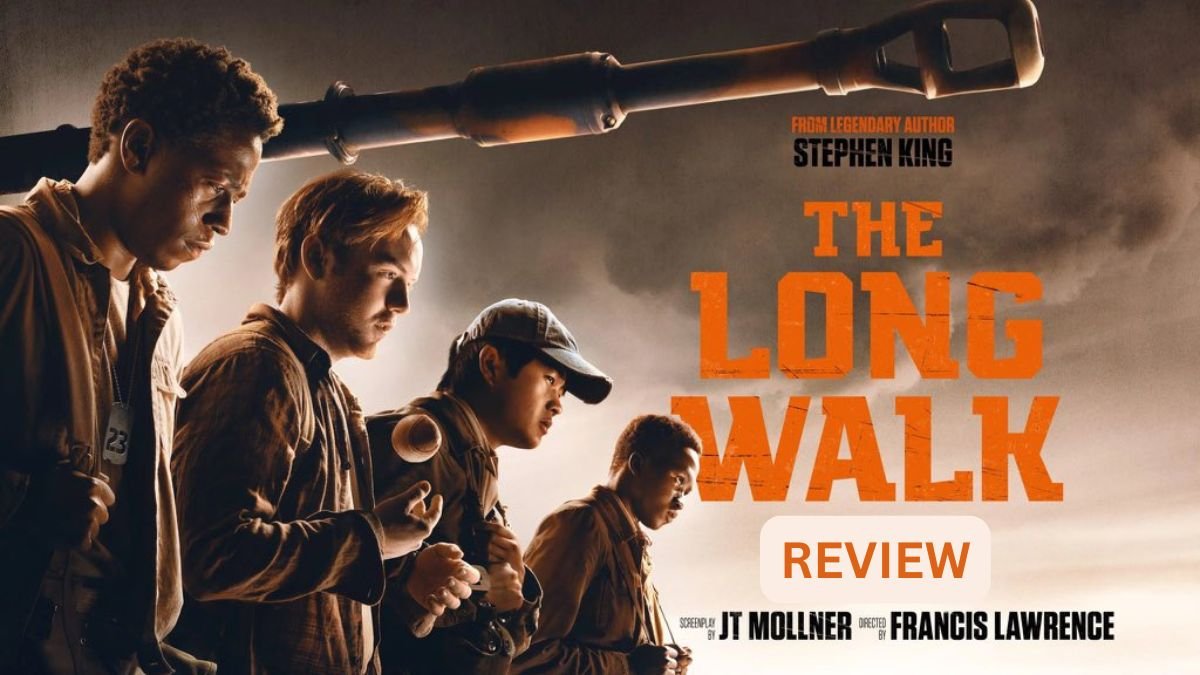
The Long Walk Review: A Harrowing March with Heart and Hell
The Long Walk Review by Kausalya Rachavelpula
The Long Walk is one of those rare films that manages to feel both brutally simple and deeply unsettling. Directed by Francis Lawrence, whose previous work on the Hunger Games franchise proved his ability to balance spectacle with human drama, this adaptation of Stephen King’s early dystopian story offers a raw, stripped‑down experience that lingers long after the credits roll.
On the surface, the premise is stark: a large group of young men participate in an annual endurance contest where failure to maintain a set pace means immediate death. The rules are ruthless, the stakes unimaginably high, and the entire ordeal is broadcast as a public spectacle. This simple framework becomes the engine for a story about camaraderie, resilience and the human cost of survival under extreme pressure.
The film’s greatest strength is its commitment to atmosphere. There are no flashy set pieces here, instead, The Long Walk unfolds almost entirely on an empty highway, flanked by fields and open skies that sometimes resemble a faded photograph. This visual minimalism emphasises the bleakness of the characters’ situation and places the audience right alongside them, step by weary step. The feeling of endlessness is palpable and often exhausting, much like the marathon itself.
Central to the film’s emotional core are the performances of Cooper Hoffman and David Jonsson, who play two of the walkers. Their evolving friendship, from instinctive camaraderie to profound dependency, forms the heart of the narrative. Hoffman portrays Ray Garraty with quiet intensity, giving the role a melancholic vulnerability without ever resorting to melodrama. Jonsson’s Peter McVries brings a warm, almost philosophical presence that often contrasts with the horror unfolding around them. Many critics have praised this chemistry as one of the film’s most compelling elements.
Yet, while the characters at the centre are compelling, the script sometimes leaves others underdeveloped. With such a large ensemble cast, it is difficult for the film to fully explore each individual’s backstory or motivations, and this can make some figures feel like sketches rather than fully formed personalities. Some viewers will find this approach immersive and reflective of the book’s focus on a handful of relationships, but others might wish for a broader emotional tapestry.
The pacing of the movie is another point of contention. At times, the slow build and repetitive nature of the walk can feel oppressive, a deliberate choice, perhaps, to mirror the characters’ ordeal. Still, there are moments when this determined plod risks becoming monotonous, testing the patience of even the most committed viewer. The film challenges rather than indulges its audience, demanding attention without the usual bells and whistles of modern blockbusters.
Technically, The Long Walk is impressive. The cinematography is disciplined and evocative, capturing the oppressive sun, the fury of dust storms and the physical decay of the competitors with understated precision. The score complements the visuals without overwhelming them, building tension in places where silence might have been too blunt a choice. It is a film that trusts its visual and sonic language to carry much of its weight.
However, not every aspect lands perfectly. Some critics argue that the adaptation shies away from exploring the broader societal context that underpins the story’s dystopian world, leaving questions about the contest’s purpose and the society that allows it somewhat vague. This lack of world‑building may frustrate those hoping for a more expansive critique of authoritarian control or televised violence.
Despite these limitations, The Long Walk feels like a serious and thoughtful adaptation. It is brutal, yes, many of the deaths are unflinching and stark, but it is never gratuitous. The focus on human connection, endurance and the psychological strain of hopelessness gives the film a depth that keeps it compelling even when it is at its most demanding.
The Long Walk Review: The Long Walk is not a light night at the cinema. It is a gruelling, emotionally charged journey that demands patience and empathy. Yet for those willing to engage with its slow burn and bleak vision, it offers moments of genuine poignancy and a haunting reflection on what it means to survive, not just physically, but emotionally.