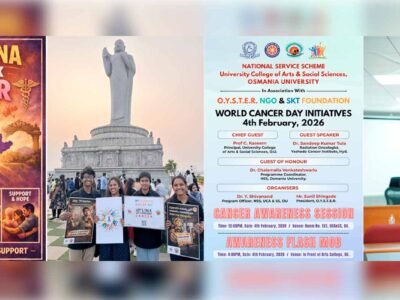

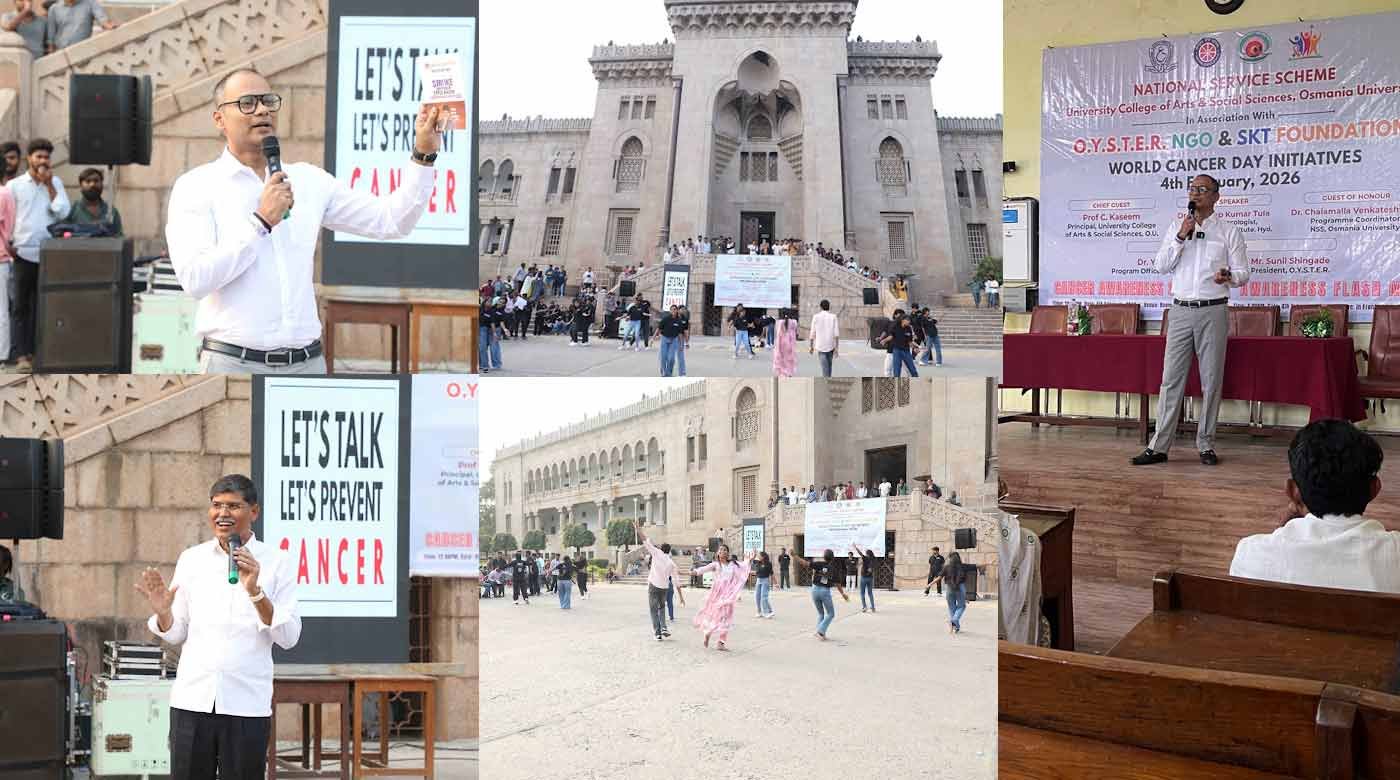
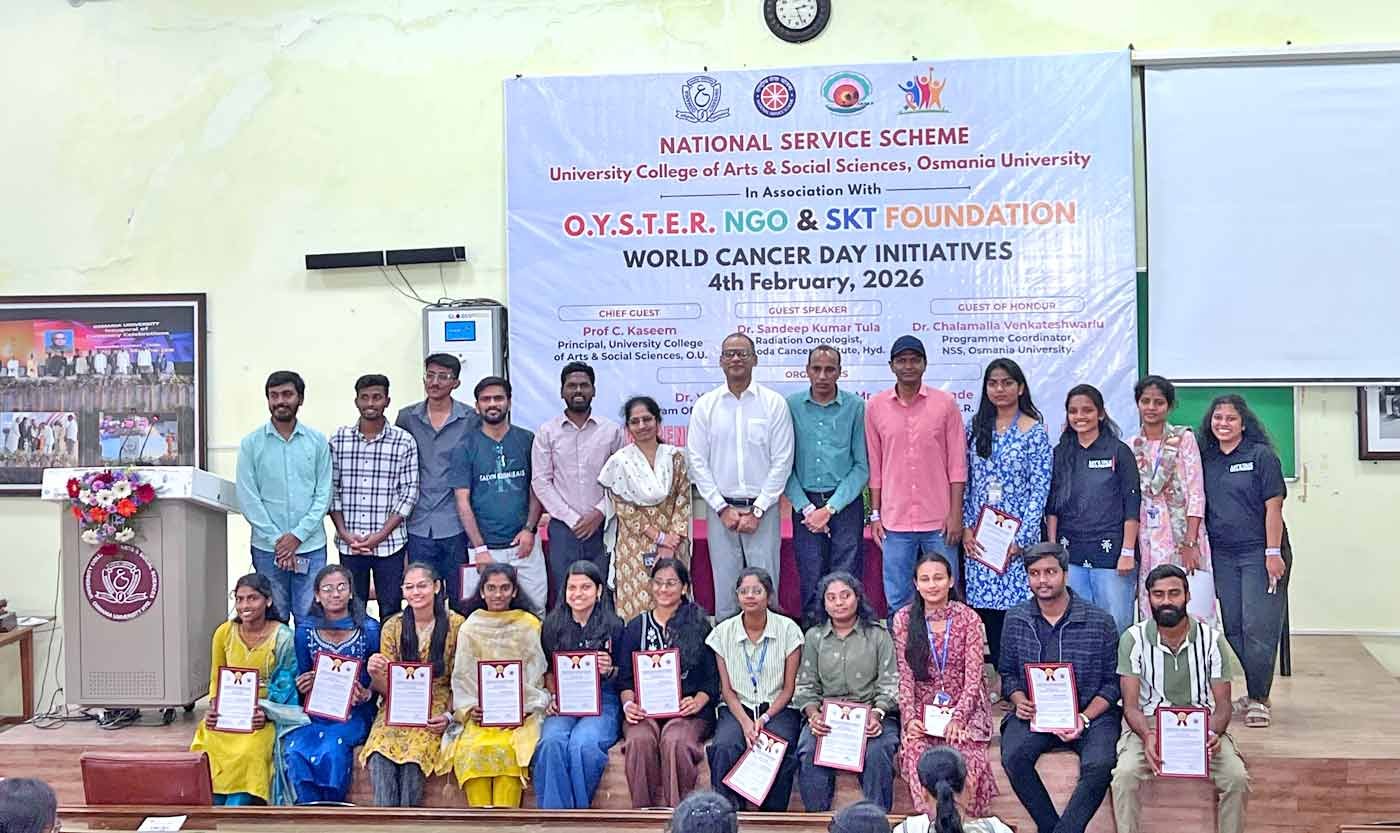
Renowned Radiation Oncologist Dr. Sandeep Kumar Tula, founder of SKT Foundation, lead a vibrant cancer awareness session at Osmania University today, coinciding with World Cancer Day. Chief guest Prof. C. Kaseem, Principal of Arts & Social Sciences, along with guest of honor Dr. Challamalla Venkateshwarlu, organizers Dr. Y. Shivanand (NSS Program Officer, Osmania University), Osmania University lecturers, and Sunil Shingade (President, O.Y.S.T.E.R.) joined enthusiastic students and volunteers for a vibrant session capped by an exhilarating flash mob.
In a collaborative effort, SKT Foundation volunteers joined forces with NSS students from Osmania University to organize an energetic flashmob, aimed at educating the community on early detection, prevention, and support for cancer patients.
Addressing students and faculty during a cancer awareness session organised by the National Service Scheme (NSS), University College of Arts & Social Sciences, in association with SKT Foundation, Dr. Tula said, “Early detection and vaccination aren’t options. they’re lifelines. HPV-related cancers are among the most preventable cancers we face today.”
Human Papillomavirus (HPV) is a group of over 100 virus strains, of which high-risk types, particularly HPV 16 and 18 are responsible for nearly 70 percent of cervical cancers worldwide, along with cancers of the throat, anal canal, penis, vulva and vagina. What makes HPV especially dangerous, Dr. Tula explained, is its ability to remain asymptomatic for years, silently triggering cellular changes before cancer is detected.
“Survival rates can exceed 90 percent when cancer is caught early,” he noted, adding that late-stage diagnosis drastically reduces outcomes. Regular screening through Pap smears and HPV DNA tests, along with routine health check-ups, remains critical, especially for women and high-risk groups.
A major focus of the session was the HPV vaccine, which acts as a pre-emptive shield by producing antibodies that neutralise the virus before infection. Dr. Tula stressed that vaccination is most effective when administered before sexual exposure, but benefits both boys and girls, with no strict upper age limit. HPV vaccination can prevent up to 90 percent of related cancers if adopted widely,” he said, urging parents, educators and policymakers to treat it as a public health priority.
The awareness initiative extended beyond the lecture hall with an energetic flash mob by student volunteers later in the day, transforming the campus into a space for public engagement and dialogue. The effort reflects the mission of SKT Foundation, a grassroots public health initiative working on menstrual health and hygiene and cancer awareness, particularly in schools and underserved communities, while advocating preventive education and systemic change.
Dr. Tula concluded with a clear call to action: control lifestyle risks, get screened regularly, and vaccinate early. On World Cancer Day, let’s not just talk about cancer, let’s stop it before it starts.