

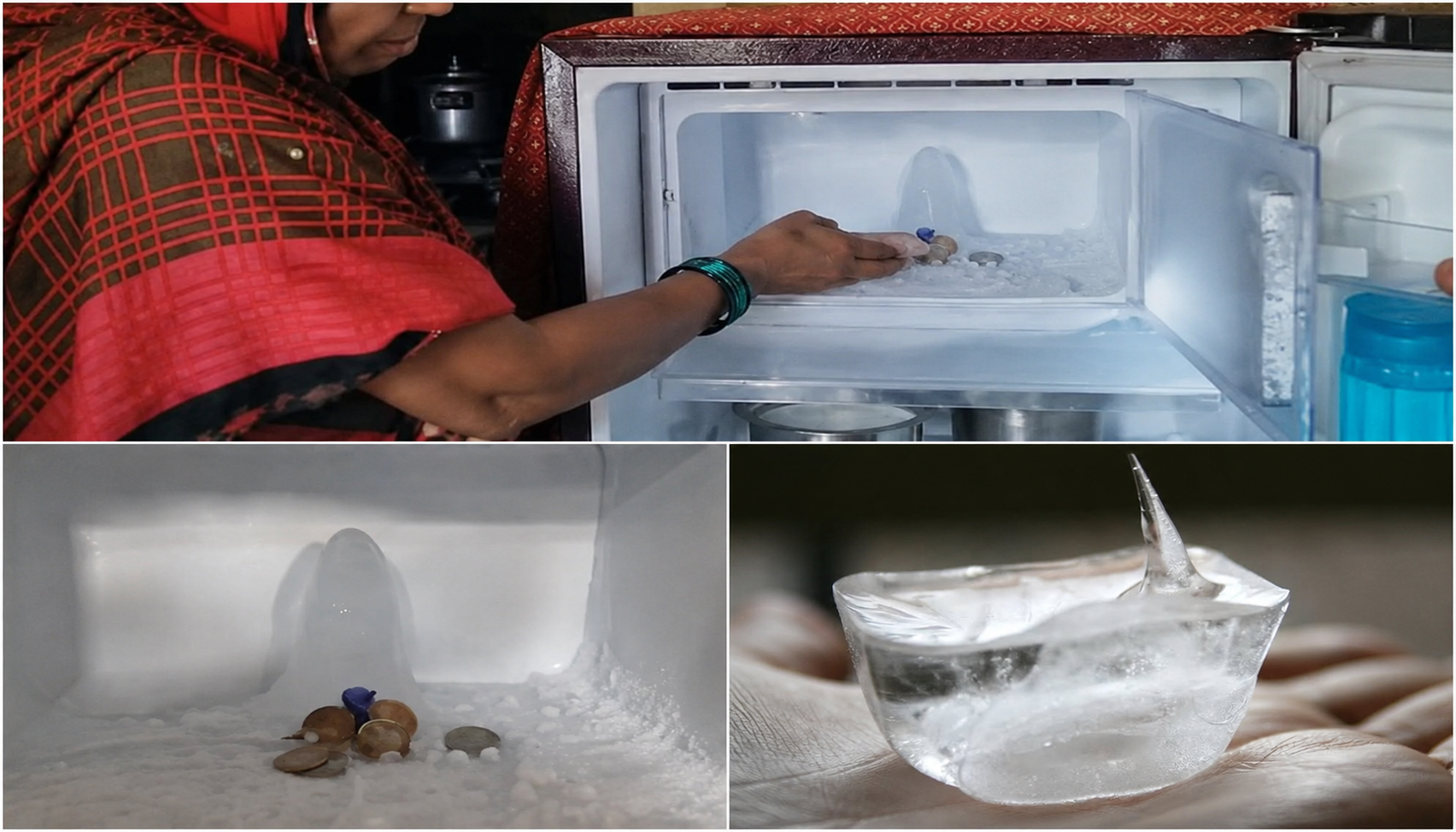
A refrigerator. An ice formation. And suddenly, a place of worship.
A family in Agra recently went viral after discovering what they believed to be a Shivling inside their refrigerator. The cone-shaped formation of ice prompted them to decorate the freezer with coins and begin offering prayers, convinced that it was a divine manifestation.
While the incident may appear harmless at first glance, it highlights a much larger issue: the tendency to mistake ordinary scientific phenomena for miracles.
The Science Is Surprisingly Simple
What formed inside the refrigerator is not uncommon. It is a well-documented physical phenomenon known as an ice spike.
An ice spike forms when water freezes from the surface inward. As water freezes, it expands by approximately 9 percent. If a tiny opening remains in the frozen surface, the increasing pressure pushes the remaining liquid water upward through that hole. As the water emerges into the cold air, it freezes around the edges, gradually creating a hollow, cone-shaped spike of ice.
The process has nothing to do with divine intervention.
In many refrigerators, factors such as a condensation leak, mineral content in the water, or an imperfect defrost cycle can make such formations even more likely.
Why Our Brains See Meaning Everywhere
The incident also illustrates a fascinating psychological phenomenon known as pareidolia. Pareidolia is the human brain’s tendency to recognise familiar patterns, faces, or meaningful objects where none actually exist.
It explains why some people see faces in clouds. Why others spot animals on the Moon. Why a burnt piece of toast is sometimes believed to resemble a religious figure. Or, in this case, why an ice cone inside a freezer was interpreted as a Shivling.
Our brains are exceptionally skilled at finding patterns. It is one of the reasons humans evolved so successfully. But that same ability can sometimes lead us to perceive significance where there is only coincidence.
Faith and Critical Thinking Can Coexist
Respecting religious beliefs and embracing scientific reasoning are not mutually exclusive. Faith can offer comfort, meaning, and community. Science, meanwhile, explains how the natural world functions. Problems arise when every unexplained occurrence is immediately declared miraculous without any attempt to understand the underlying science.
Incidents like these underscore the importance of scientific literacy. Recognising an ice spike for what it is does not diminish anyone’s spirituality. It simply acknowledges the remarkable laws of physics that govern our everyday lives.
A Reminder to Stay Curious
The viral Agra incident has generated amusement across social media, with many users joking that refrigerators have now become places of pilgrimage.
Humour aside, it serves as a reminder of how easily misinformation and superstition can spread when scientific explanations are overlooked. Perhaps the next time something unusual appears in the kitchen, the first instinct should not be to gather offerings. It should be to ask a question.
After all, sometimes the most extraordinary discoveries are not miracles at all. They are simply science waiting to be understood. And perhaps it is time we spent a little less time searching for divine signs inside our refrigerators and a little more time reading the appliance manual.