

A famous line, a legendary emperor and the continuing journey of Telugu
“Desa Bhashalandu Telugu Lessa.”
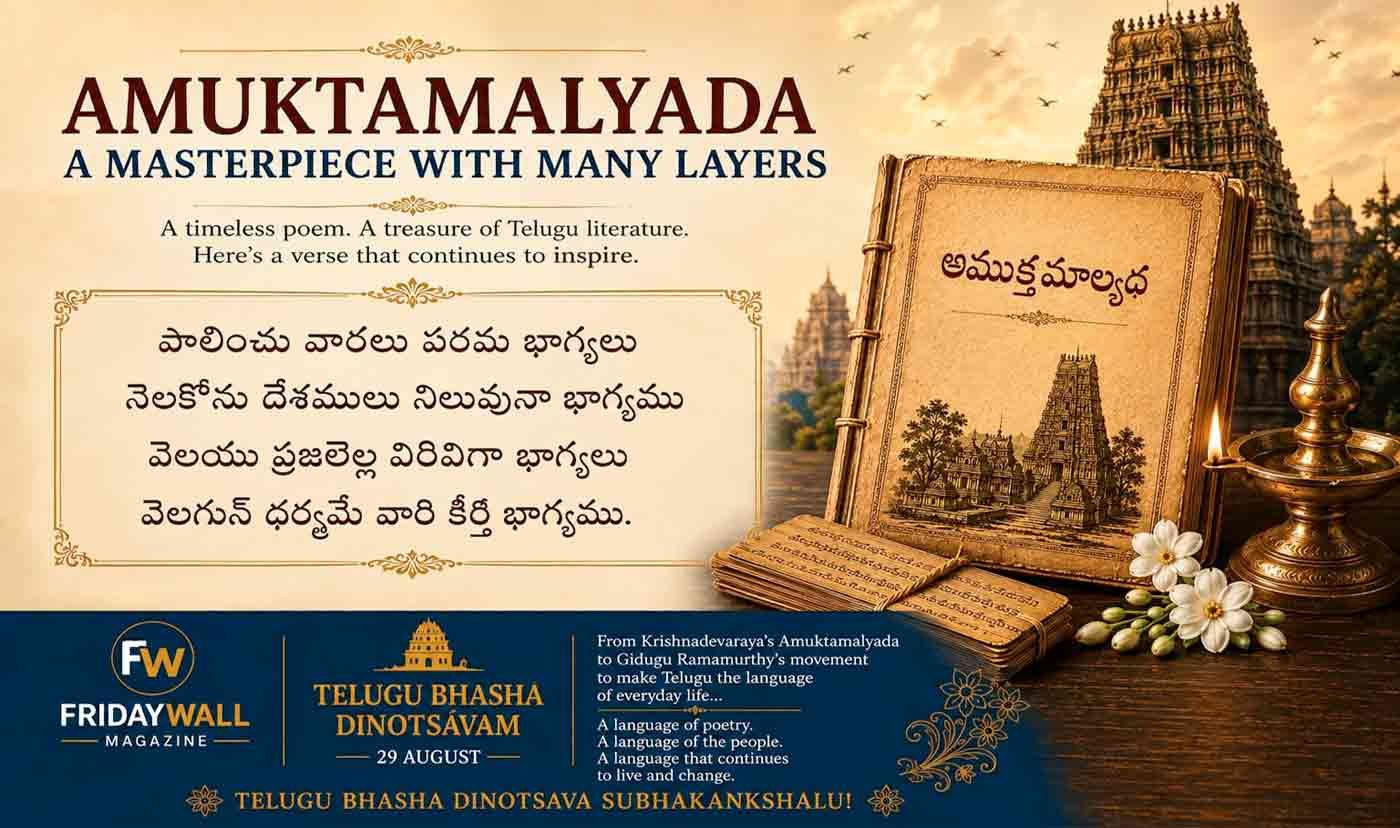
For generations, these words have been repeated as an expression of pride in Telugu. They are intimately associated with Sri Krishnadevaraya and Amuktamalyada, his celebrated Telugu literary work.
On August 29, observed every year as Telugu Language Day or Telugu Bhasha Dinotsavam, the familiar phrase provides a fascinating starting point from which to explore a much bigger story — of a language shaped by poets and emperors, reformers and ordinary speakers.
The date itself commemorates the birth anniversary of Gidugu Venkata Ramamurthy, the writer and linguist whose advocacy of Vyavaharika Bhasha helped bring written Telugu closer to the language spoken by its people. Government sources recognise August 29 as Telugu Bhasha Dinotsavam and Gidugu’s contribution to the development and popularisation of the language.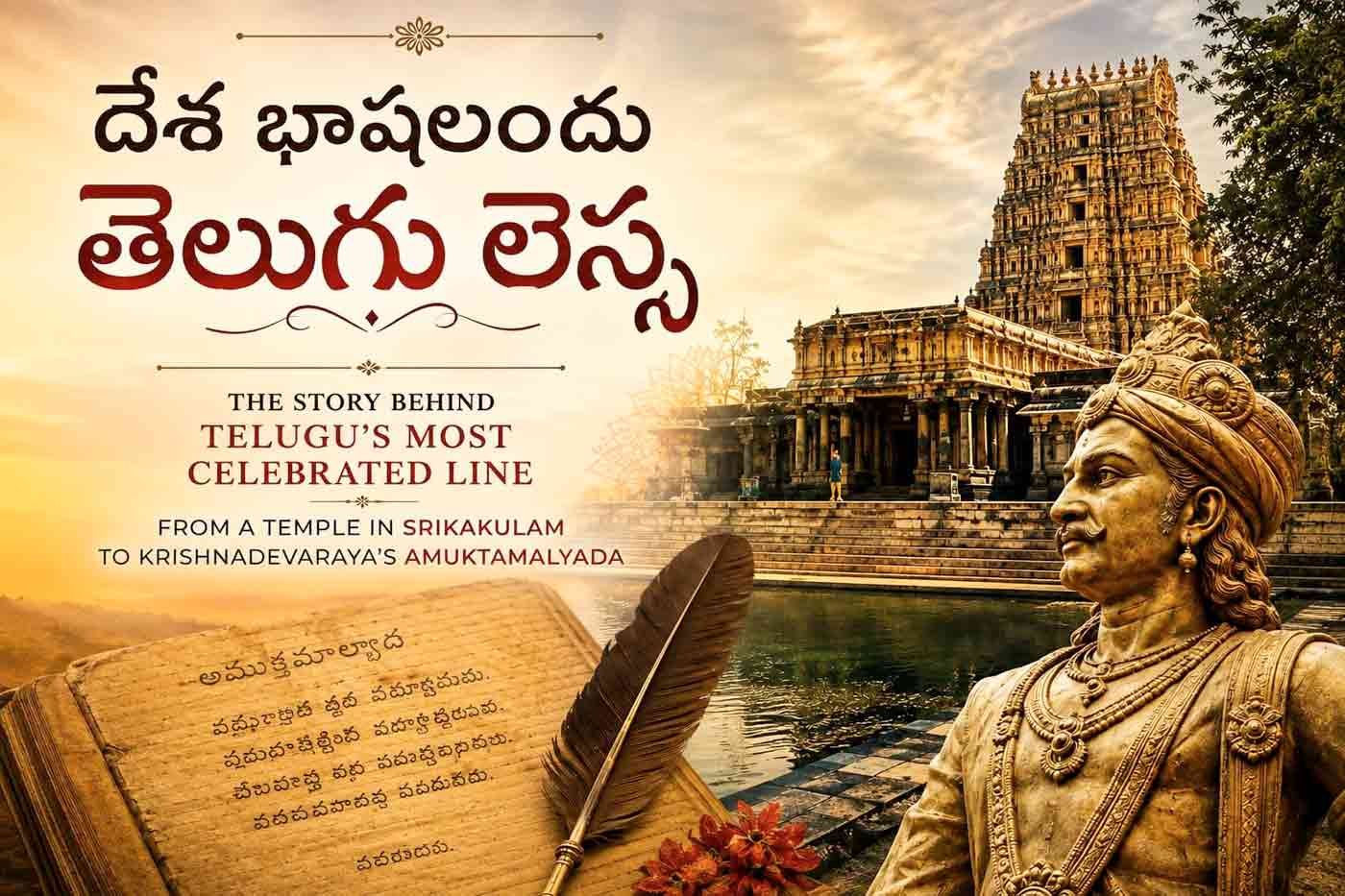
Krishnadevaraya: an emperor who was also a poet
Sri Krishnadevaraya ruled the Vijayanagara Empire between 1509 and 1529 and presided over one of the great periods of literary patronage in South India.
His court is famously associated with the Ashtadiggajas, the eight celebrated Telugu poets. But Krishnadevaraya was not merely a royal patron watching literature flourish around him. He was a writer himself.
His Amuktamalyada became one of the landmarks of Telugu literature. Telangana’s SCERT records Krishnadevaraya as the author of Amuktamalyada and also associates him with the celebrated assertion of Telugu’s excellence among languages.
At the heart of Amuktamalyada is Goda Devi, or Andal, the poet-saint remembered for her extraordinary devotion to Vishnu.
Yet to read Amuktamalyada merely as a devotional narrative is to miss some of what makes the work fascinating centuries later. Its literary canvas extends into observations on society, administration, kingship, hospitality and everyday life.
It is literature, but it is also a window into another time.
The words that outlived an empire
Among everything associated with Amuktamalyada, one expression acquired a cultural life all its own:
“Desa Bhashalandu Telugu Lessa.”
Over time, the words travelled beyond their literary setting. They entered speeches, textbooks, cultural celebrations and popular memory, becoming almost shorthand for pride in Telugu.
The longevity of the expression is particularly striking. The Vijayanagara world in which Krishnadevaraya lived disappeared centuries ago, but the words continue to be invoked wherever Telugu language and identity are celebrated.
From classical literature to Vyavaharika Telugu
There is another story that makes August 29 especially significant.
Centuries after Krishnadevaraya, Gidugu Venkata Ramamurthy confronted a very different question about Telugu.
Could a great language truly flourish if the Telugu used in formal writing and education remained distant from the Telugu spoken by ordinary people?
Gidugu became one of the leading advocates of Vyavaharika Bhasha, arguing for the use of a more accessible form of Telugu rather than restricting writing to highly formal literary conventions.
The Press Information Bureau notes that his language movement sought to make Telugu literature comprehensible to common people. His birth anniversary is consequently commemorated as Telugu Language Day.
That connection creates an intriguing arc in the history of the language.
Krishnadevaraya represents Telugu reaching extraordinary literary heights.
Gidugu represents the argument that Telugu must also remain accessible to the people who speak it.
A language survives by changing
Telugu Bhasha Dinotsavam is therefore about more than celebrating antiquity.
The Ministry of Information and Broadcasting notes that Telugu Language Day is observed annually on August 29 to celebrate the linguistic and cultural heritage of Telugu and that the language has continually evolved through political, social and cultural transformations.
That evolution continues today.
Telugu lives in classical poetry and contemporary fiction, in cinema dialogues and song lyrics, newspapers and digital journalism, family conversations, memes, podcasts, reels and WhatsApp messages.
The language on a centuries-old manuscript and the Telugu typed on a smartphone screen may look and sound different. That difference is not necessarily a sign of decline. It is also evidence of a living language responding to the people using it.
The challenge is to ensure that evolution does not become disconnection — that younger generations can embrace contemporary Telugu while still having pathways into its extraordinary literary inheritance.
Perhaps that is why the journey from Amuktamalyada to Gidugu Ramamurthy feels particularly relevant on Telugu Language Day.
One reminds us of what Telugu has created.
The other reminds us whom a language ultimately belongs to.
And somewhere between the two lies the continuing story of Telugu — a language that carries centuries of literature while finding new words, new formats and new audiences with every generation.
దేశ భాషలందు తెలుగు లెస్స.
Five centuries later, the words still resonate. But the most meaningful celebration of Telugu may be simpler: to keep speaking it, reading it, writing it and allowing it to live.
తెలుగు భాషా దినోత్సవ శుభాకాంక్షలు.