
Fridaywall is kicking off a fresh bi-monthly book feature with Hyderabad’s own academic, poet, and critic Jhilam Chattaraj. We’re putting the spotlight on poetry books coming out of India and beyond, keeping it real and relevant.
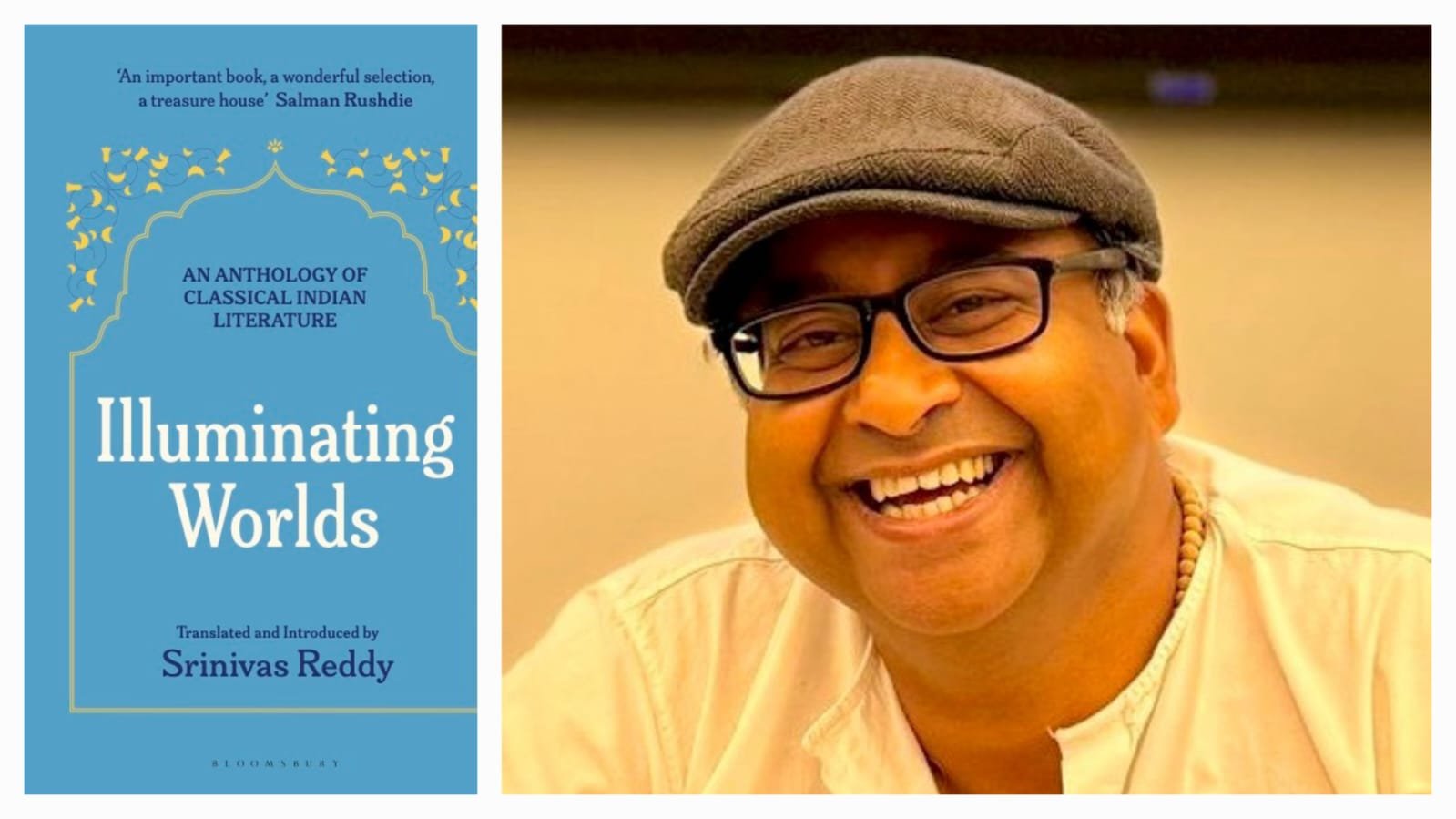
Book in Focus : Illuminating Worlds: An Anthology of Classical Indian Literature, Bloomsbury, 2024
by Srinivas Reddy
About the Author: Srinivas Reddy is a scholar, translator and classical sitarist. He has published five books including Raya: Krishnadevaraya of Vijayanagara (Juggernaut 2020) and Illuminating Worlds: An Anthology of Classical Indian Literature (Bloomsbury 2024). He is currently on a Fulbright-Nehru fellowship at IIT Gandhinagar. www.sankalpana.org
About the Book: Srinivas Reddy’s Illuminating Worlds sheds light on the enduring wisdom of classical Sanskrit texts. In an era dominated by rapid digital communication and frequent incendiary exchanges, the book offers a glimpse into a time when love and tolerance shaped society. The richness and diversity of these texts prompt readers to question today’s knowledge systems. With a critical Introduction, the anthology serves as a valuable resource for scholars of Indian languages and translation studies, encouraging a fresh understanding of power and influence. The collection organizes over thirty texts into eight thematic chapters arranged chronologically: Vedic hymns, philosophy and religion, the Sangam corpus, epic literature, court poetry, narrative literature, later mythologies, and the rise of Bhakti. The author describes the anthology as an invitation to slow down and immerse oneself in literature, appreciating the subtle beauty of ancient verses. A quote from George Steiner in the Introduction sums up the core theme of the book: “To understand is to decipher. To hear significance is to translate.”
Extracts from Illuminating Worlds
I
“Spiritual growth comes in many forms, but the foundation must be tolerance, for one’s own religion
should not be praised, nor should another religion be condemned or treated lightly”
Rock Edict XII, 256 BC
II
“The moon is in the water, the bright-rayed sun
Courses through the sky;
They cannot find your path, O golden-tipped lightning.
Know this of me, O heaven and earth!”
I.105, ‘Hymn to All Gods,’ p.24
III
1. Motion, Rest, Space and Matter are non-sentient realities
2. These realities have substance, as do souls.
3. They are eternal, steady and non-material.
4. Except for Matter, which has materiality.
5. Motion, Rest and Space are each made up of only one substance
6. And they are stationary.
7. Motion and Rest have innumerable units.
8. A soul has innumerable soul units.
9. Space has an infinite number of space units.
10. Matter may have numerable or innumerable units.
11. But an atom of Matter has only one unit.
12. The four substances exist in cosmic space.
13. Motion and Rest fully occupy cosmic space.
14. A cluster of Matter may occupy one, numerable or innumerable units of space.
15. A soul may occupy an innumerable part, or more, of cosmic space.
The Meaning of Being, Tattvārtha Sūtra of Umāsvāti, V, P. 93
IV
Let us meditate on the eternal, ultimate Truth,
Self-resplendent and devoid of deception;
The effulgent and omniscient one present in all things,
From whom comes the beginning, middle and end;
Through whom the creation of the Three Qualities
Truly transforms Fire, Water and Earth;
And through whose heart the Vedas, which bewilder the wise,
Are revealed to the primeval poet Brahma.
Here in this holy Bhagavatam, composed by the great sage,
The highest dharma of righteous people free of envy
Is explained without falsehood.
The thing to be known here is the Real
Which roots out the Three Troubles and offers prosperity.
Can any other text give an immediate heartfelt experience of God?
Here, God is attained instantaneously
By the righteous willing to listen.
The Bhagavatam is the ripe fruit of the Vedic Tree of Imagination,
Sprung from Shukra's lips like flowing nectar!
Dear devotees who savour aesthetic emotions and moods
Right here, right now, you can drink the Bhagavatam
Which flows with aesthetic sentiments.
Bhāgavata Purāņa, Book I, Chapter 1, p.304
About the poet, writer and curator Jhilam
Jhilam Chattaraj is an academic, critic and poet. She teaches at the Department of English and Foreign languages, RBVRR Women’s College, Hyderabad. She has authored the books: Sudeep Sen: Reading, Writing, Teaching, Noise Cancellation (2021), Corporate Fiction: Popular Culture and the New Writers (2018), and When Lovers Leave and Poetry Stays (2018). Her works have been published in Michigan Quarterly Review, Mekong Review, Ecocene, New Contrast Magazine, One Art Poetry Journal,Calyx, Ariel, Room, Porridge, Queen Mob’s Tea House, Colorado Review,World Literature Today and Asian Cha among others. She received the CTI Excellence Award in ‘Literature and Soft Skills Development’ (2019), from the Council for Transforming India and the Department of Language and Culture, Government of Telangana, India. Her poem, ‘Sari’ was nominated for the Nina Riggs Poetry Award (2023).