

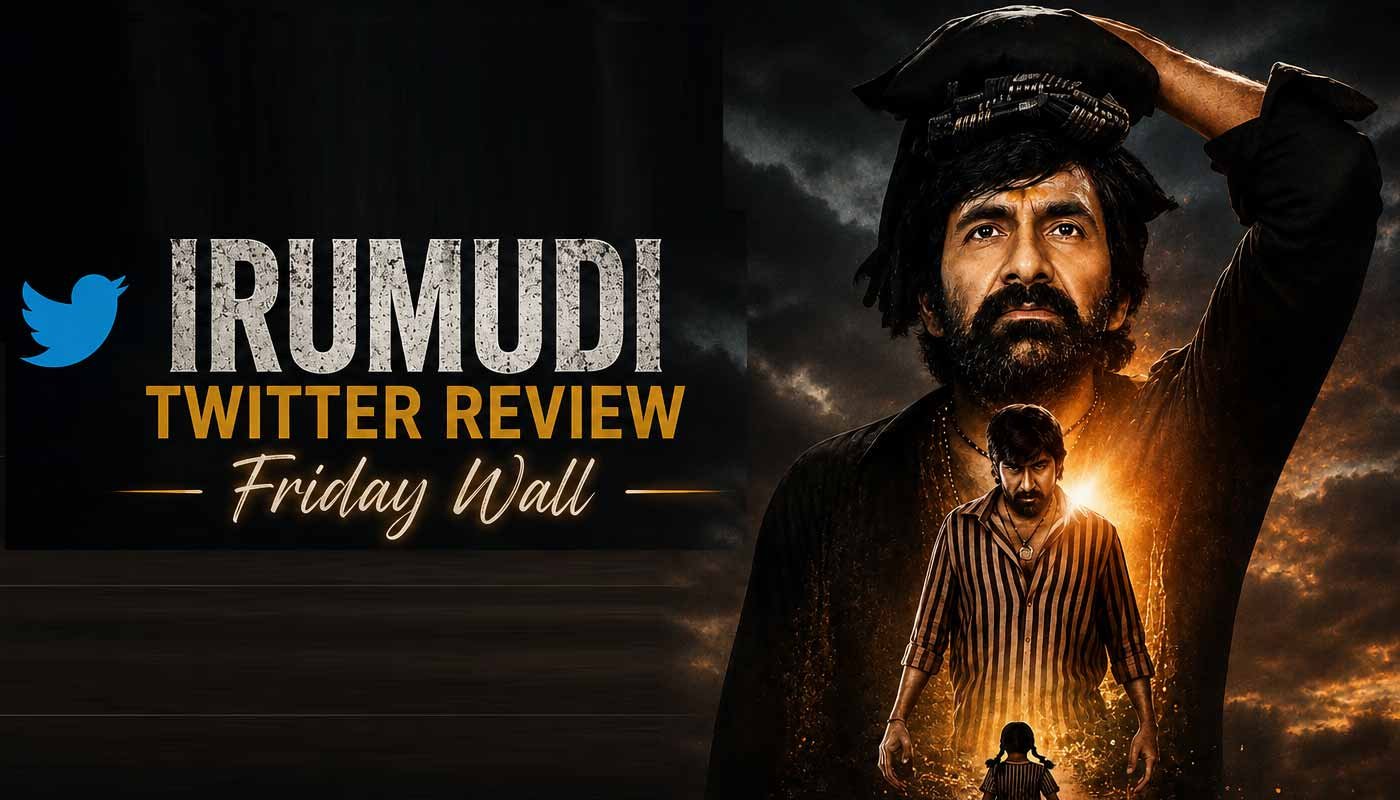
Ravi Teja’s Irumudi arrived in theatres on August 21 amid considerable curiosity around the actor stepping away from his familiar mass-entertainer territory. If the first reactions on X, formerly Twitter, are anything to go by, the change of direction appears to have worked.
Directed by Shiva Nirvana, Irumudi is being described in early social-media reactions as an emotional family drama that combines action and suspense with a socially relevant theme. Ravi Teja’s performance, the father-daughter relationship, the interval and the emotionally charged second half are emerging as the biggest talking points after the US premieres and early shows.
Ravi Teja Is Back, Say Early Irumudi Reactions
One sentiment dominates many of the early reactions: viewers are happy to see a different Ravi Teja.
Instead of building the film entirely around the Mass Maharaja persona, Shiva Nirvana places Ravi Teja in the role of Trinath, a family man and father whose relationship with his daughter becomes central to the story.
“Finally, Ravi Teja is back,” wrote one viewer on X, summing up a reaction echoed by several early posts. Another audience member described the film as a redemption of sorts for Ravi Teja and particularly praised his acting, screenplay and interval sequence.
The response is significant because Irumudi asks Ravi Teja to dial down some of the mannerisms traditionally associated with his commercial entertainers. His performance is being appreciated for bringing vulnerability, anger and affection to the character while retaining enough of his familiar screen energy.
Father-Daughter Emotion Drives Irumudi
At its core, Irumudi revolves around Trinath and his daughter Manemma, played by Baby Nakshathra. He raises her to be confident and fearless, encouraging her to speak openly to him when something is wrong.
That relationship appears to be the film’s strongest emotional hook.
Several early reactions also point to the larger idea behind the film: how families raise and protect girls and how parents respond to the dangers young women face.
Social-media reactions from the premieres describe Irumudi as a film likely to connect particularly with parents. Sai Kumar’s presence and dialogues are also being singled out, especially in sequences dealing with family, children and responsibility.
First Half Brings Suspense, Second Half Turns Emotional
The response to the first half is largely favourable, with viewers highlighting the father-son portions, suspense elements and particularly the interval sequence.
The second half shifts more decisively towards emotion and the film’s central social theme.
One viewer who watched an early show described it as a good first half followed by a phenomenal second half, while recommending it as a film to watch with the family. Another early reaction called Irumudi empowering and engaging for taking up a socially relevant subject while staying within the framework of a mainstream entertainer.
The response, however, is not completely without reservations.
Some early reactions suggest that once a major twist is revealed, the portions that follow could have been written more sharply. The emotional payoff and climax appear to compensate for this for many viewers, although the second-half writing and pacing could divide audiences.
GV Prakash Kumar’s Music Gets Noticed
GV Prakash Kumar’s background score is another element receiving attention. The music adds weight to both the suspense and emotional portions, while the use of Mallepoola Pallaki during an action sequence has reportedly turned into a crowd-pleasing theatrical moment.
Baby Nakshathra is also receiving appreciation for her natural performance and chemistry with Ravi Teja. Priya Bhavani Shankar gets an emotionally substantial part, particularly as the story progresses.
Irumudi Twitter Review Verdict
The opening X verdict suggests that Irumudi may be the change of pace Ravi Teja needed.
Interestingly, the film is not being celebrated primarily as another high-decibel Ravi Teja mass vehicle. Instead, much of the positive conversation is centred on his performance, the family emotion, the father-daughter relationship and Shiva Nirvana’s attempt to bring a socially relevant subject into a mainstream Telugu film.
There is action and there are moments designed for Ravi Teja’s core audience, but the early word suggests that Irumudi is more interested in the father than the star.
For Ravi Teja, that change may prove to be the film’s biggest strength.
Fridaywall Verdict
The early word on Irumudi is largely positive. Ravi Teja’s restrained performance, the father-daughter emotion, interval and emotional climax lead the praise, while the writing following the film’s major reveal appears to be the principal point of criticism.