

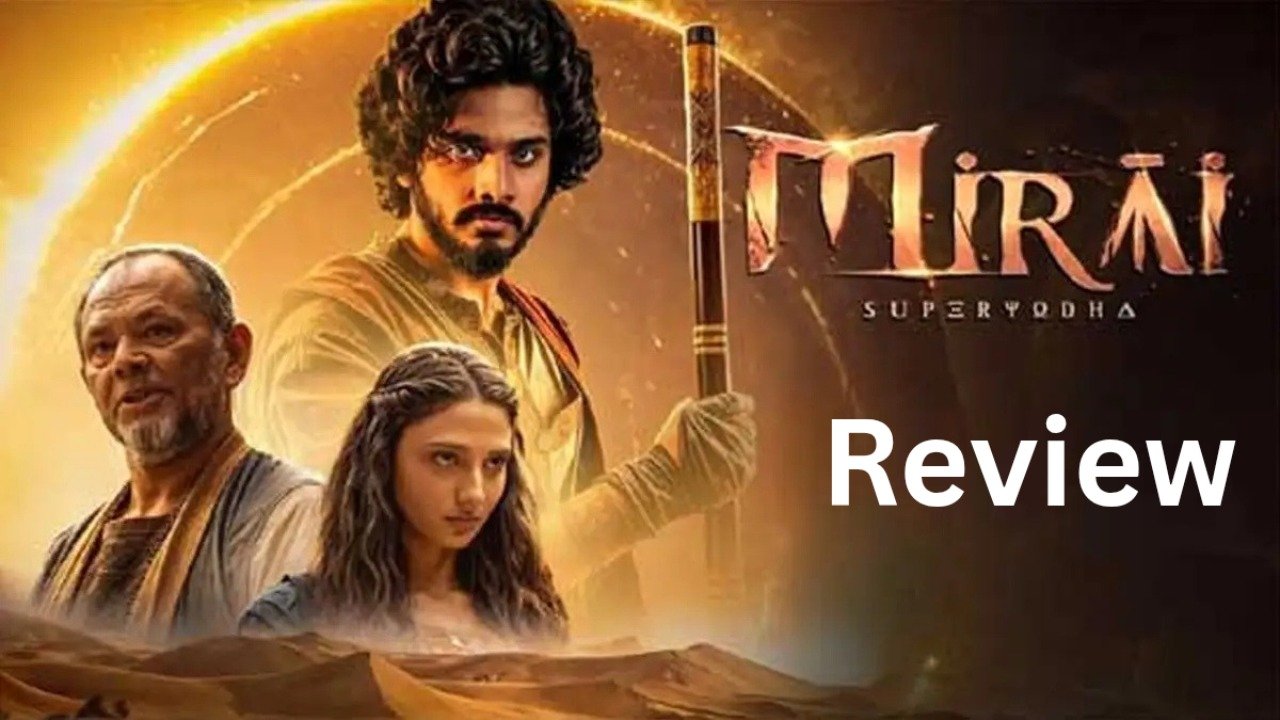
Mirai Review: A Fantasy Adventure That Turns Boring
After the roaring success of Hanu-Man, expectations were naturally sky-high for Teja Sajja’s next outing, Mirai. Directed by cinematographer-turned-director Kartik Gattamneni, the film sets out to blend ancient mythology with modern fantasy in a spectacle-driven narrative. But does it succeed?
Drawing inspiration from Emperor Ashoka’s legendary “nine unknown books,” Mirai begins with a fascinating premise. The story explores how these ancient secrets, hidden for centuries, resurface in the modern world, pulling together destiny, power, and mystery. At the heart of it lies Vedha Prajapathi, played by Teja Sajja, whose carefree life takes an unexpected turn when he becomes connected to this legacy. From there, the film unfolds into a larger battle involving myth, immortality, and a clash between good and evil. What exactly is Mirai—a book, a power, or something far greater? The film builds on this suspense and leaves the audience eager to discover the answers.
The core idea has undeniable potential, but the treatment falters. Instead of unfolding like a racy adventure, parts of the film feel stretched and dull. The narrative often plays out like a pseudo-documentary, weighing the story down instead of immersing the audience in its fantasy world. At times, the film reminds you of Percy Jackson, but without the same sense of wonder or charm. It feels almost as if Chandamama kathalu were adapted in a heavy-handed, serious way instead of embracing their playful storytelling spirit. For one section of the audience, especially those who enjoy mythological retellings with a modern twist, the movie may resonate. But for many others, it risks being boring. Manchu Manoj’s character, the character origins are sympathetic but the journey and ending of the character is badly written. Don’t understand why do we keep listen a lot of Mughal names nowadays.
The cast, however, is easily the film’s biggest strength. Teja Sajja once again proves his mettle in action-fantasy roles. Manchu Manoj makes a solid impact as the menacing antagonist. Jagapathi Babu lends his usual gravitas, and Shriya Saran is graceful and convincing in her part.
On the technical side, Kartik Gattamneni’s cinematography gives the film a rich visual texture, and the grand frames suit its epic ambitions. The background score is another highlight, elevating several sequences even when the writing lags, with the BGM standing out as particularly impressive.
In the end, Mirai is a film made with ambition, strong visuals, and good performances, but the storytelling does not match up to its potential. The pacing issues and documentary-like execution make it feel more like a missed opportunity than a thrilling fantasy ride. A section of the audience will enjoy its one religious mythological depth, but for many, the film may come across as underwhelming.
Mirai review: Overall, Mirai can be summed up as ambitious yet uneven, captivating in parts but weighed down by its own seriousness. The movie tries to merge history, mythology, and modern fantasy but doesn’t quite find the balance needed to keep viewers fully engaged.
Rating: 2/5