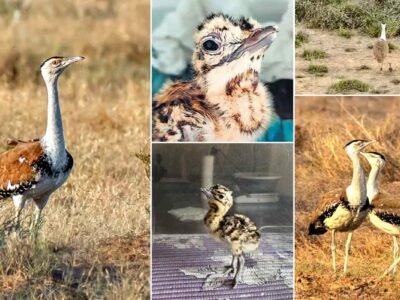

Bustard Chick Spotted after a Decade – A rare sighting in Gujarat’s grasslands brings renewed hope for the survival of the critically endangered Great Indian Bustard and India’s fragile ecosystem.
For many of us, the Great Indian Bustard is not a bird we grew up seeing in the wild, but one we vaguely remember from nature documentaries, often watched at our parents’ insistence; it existed more on television screens than in reality, making the recent sighting of its chick not just rare, but deeply nostalgic and profoundly significant. Those are the sights of birds we might have seen.
Indian Endangered Species
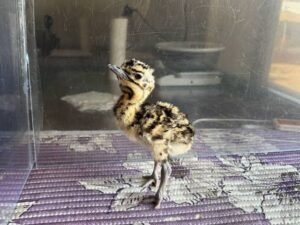
Bustard Chick. The name itself says it is a foreign bird that is rare and seen in bird sanctuaries, but no, it was recently spotted in Gujarat, specifically in the grasslands of the Kutch District (Abdasa region).
This marks the first such sighting in the wild in nearly a decade, making it a major conservation milestone for India’s critically endangered Great Indian Bustard.
In a moment that has rekindled hope among conservationists, a chick of the critically endangered Great Indian Bustard has been spotted in India after nearly a decade. The sighting is being hailed as a significant breakthrough in the ongoing efforts to revive one of the country’s most threatened bird species.
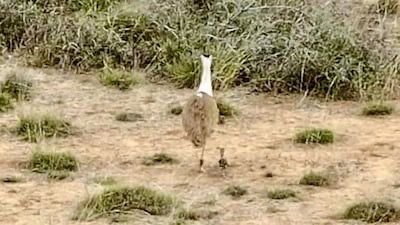
Decline of Grassland Giant
Once widespread across the grasslands of India, the Great Indian Bustard has seen a dramatic population decline over the years, primarily due to habitat loss, agricultural expansion, and fatal collisions with overhead power lines. Today, the species is largely confined to parts of Rajasthan and Gujarat, with its population estimated to be alarmingly low.
The recent sighting of a chick indicates successful breeding in the wild, an encouraging sign for conservation programmes that have been working tirelessly to protect and restore its fragile habitat. Experts believe that such developments validate sustained efforts, including habitat protection, controlled breeding initiatives, and community awareness campaigns.
A Breakthrough in the wild
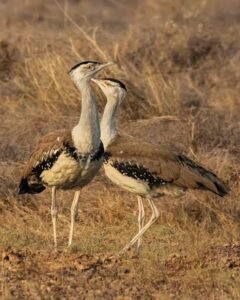
Often referred to as the “flagship species” of India’s grassland ecosystems, the Great Indian Bustard plays a crucial ecological role. Its presence is indicative of a healthy grassland habitat, which supports a diverse range of flora and fauna. The birth of a chick, therefore, is not just about one species; it signals a broader ecological revival.
Conservationists, however, remain cautiously optimistic. While the sighting is promising, they stress the need for continued protection measures, particularly the undergrounding of power lines in critical habitats and stricter enforcement of conservation policies.
Hope, with a Note of Caution
This rare event serves as a reminder that with focused efforts and collective responsibility, even the most endangered species can be given a second chance. For India’s conservation landscape, the tiny chick represents something far greater, a fragile yet powerful symbol of resilience and renewal.