

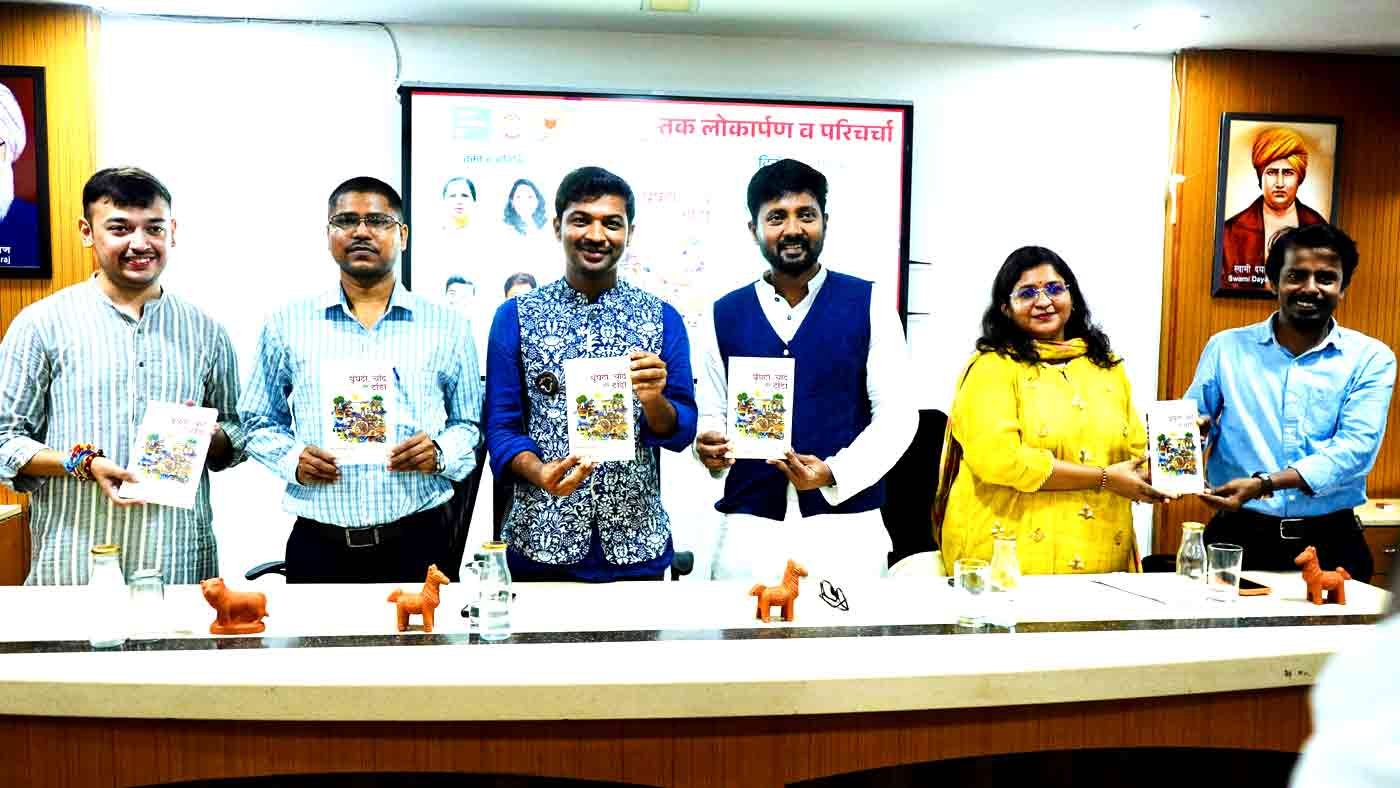
A poetry collection rooted in the life, memories and cultural world of Telangana’s Banjara community has found an enthusiastic new audience in Delhi.
Ghunghato, Chaand aur Tanda, a collection of poetry by Sahitya Akademi Yuva Puraskar-winning writer Ramesh Karthik Nayak, became the centre of a book launch, literary discussion, academic engagement and an Inter-University Hindi Creative Writing Competition organised jointly by Vani Prakashan Group and the Hindi Sahitya Parishad of Hansraj College, University of Delhi.
Translated into Hindi from Nayak’s Telugu and English writings by writer Matta Prasad Babu, the volume takes the young writer’s engagement with Banjara life and identity into another major Indian language and, significantly, to a new generation of university readers.
The response from students was substantial. Students from 12 universities and 32 colleges were invited to participate in the creative writing competition built around the book and its larger cultural context. As many as 209 students enrolled, engaging through their writing with Banjara culture, lived experience, identity and literary expression. Winners of the competition were felicitated during the programme.
For Nayak, whose literary work has consistently attempted to bring the stories, language and cultural memory of the Banjara community into contemporary literature, the Delhi event marks an interesting expansion of readership.
Born in Telangana and writing across Telugu, English and the Banjara linguistic world, Nayak has emerged as an important young voice documenting a community that has remained relatively underrepresented in mainstream Indian publishing.
He received the Sahitya Akademi Yuva Puraskar in Telugu in 2024 for Dhaavlo, his collection of short stories. The Sahitya Akademi records Dhaavlo as the 2024 Telugu Yuva Puraskar winner.
His work is particularly notable for the way Banjara language, memory and everyday life enter his writing rather than merely functioning as a backdrop. Reporting on his Sahitya Akademi recognition, The Times of India noted that Dhaavlo introduced more than 400 Banjara words into its Telugu narratives while exploring the community’s traditions and emotional worlds.
Nayak’s English poetry collection Chakmak similarly draws deeply from Banjara experience. Recent literary criticism has pointed to recurring ideas of land, nature, ancestry, belonging and the reclamation of community identity in his poetry.
In an interview with Hindustan Times, Nayak spoke about the relationship between language and representation in his work, explaining why he continues to write in Telugu even while English enables him to reach a wider readership. His literary trajectory has increasingly involved taking the Banjara experience across languages without separating it from its cultural roots.
That trajectory makes the Hindi arrival of Ghunghato, Chaand aur Tanda particularly significant.
The Hansraj College programme did not restrict itself to introducing the book to readers. It also brought the collection into an academic setting. Three scholars, including doctoral and postgraduate researchers, presented critical reviews and analyses examining its literary, thematic and cultural dimensions.
The discussions are expected to feed into continuing academic work, including doctoral research and dissertations, giving Nayak’s writing another form of engagement beyond conventional literary reviews.
The programme was attended by Aditi Maheshwari, Chief Executive Officer of Vani Prakashan Group, and Dr Ravi Kumar Gond, programme coordinator, along with scholars, students and literary enthusiasts.
Nayak’s journey has already demonstrated how writing emerging from a specific community can travel beyond geographical and linguistic boundaries. His works include the Telugu poetry collection Balder Bandi, the short-story collection Dhaavlo, Kesula, and the English poetry collection Chakmak. His poetry and books have also entered university curricula.
More recently, an interview published by Asymptote in September 2026 examined Nayak’s relationship with language, translation and indigenous identity, reflecting the growing critical interest around his work beyond Telugu literary circles.
In that context, the attention received by Ghunghato, Chaand aur Tanda in Delhi is noteworthy. A book carrying the cultural memory of the tanda — the Banjara settlement that remains central to Nayak’s literary imagination — became the starting point for hundreds of young people to read, discuss and write.
The event consequently became more than a conventional book launch. It brought together Banjara cultural heritage, Hindi translation, university scholarship and the creative responses of young readers — giving Nayak’s deeply local literary world a considerably wider stage.