


From Bethlehem Kudumba Unit and Vishwanath and Sons to 30 Weds 21 and Cheeni Kum, examining age-gap romances, gender, power and moral policing in Indian cinema reveals a recurring contradiction
Age gap romances inherently possess a cinematic tension that most conventional love stories work quite hard to generate. There are too many opposing forces that try to drift the couple apart. Love isn’t always enough. There’s an inevitable power hierarchy between the partners, based on gender, vulnerability of situation, and financial wherewithal, that dictates the direction of the relationship.
And from a storyteller’s perspective, such films also provide vast scope to critique the shallow, conventional norms of a supposedly civil society. Both recent releases that cast light on age gaps in relationships, Vishwanath and Sons (in Tamil) and Bethlehem Kudumba Unit (in Malayalam), tick all these boxes while operating in contrasting terrains, backed by the carefully crafted appeal of their protagonists.
The glorification of the bare minimum
In Vishwanath and Sons, the man, a filthy-rich entrepreneur, possesses an unusual advantage over a woman who is 20 years younger than him. Sanjay Vishwanath’s (Suriya) need to have a child stems from repeated societal pressure to have a companion and an heir who can take the familial legacy forward. Interestingly, when he opts for a surrogate child, the baby happens to be a son.
When a medical need prompts Sanjay to connect with the surrogate mother, she is revealed as a carefree 22-year-old orphan in the US, Maddy (Mamitha Baiju), who bore the child to cover her tuition expenses. Her return to India to help Sanjay’s child materialises through another financial deal. Maddy, almost playfully, milks the situation to facilitate her materialistic needs, which come as part of the package.
In no time, she is swooning over him, encouraged by his mother, who is eager to get her middle-aged son married. Maddy watches him be a good boss, a responsible son, and a defender fighting men who cause her trouble. There’s a more colourful side to his too-good-to-be-true image, as he has his share of fun with women from dating apps under the guise of official trips.
In several instances, Sanjay is glorified for doing the bare minimum, so much so that his basic dignity becomes his X factor. He understands the exploitative nature of the situation and resists expressing his feelings for that very reason. He repeatedly stresses how Maddy is his responsibility come what may, positioning him as a protective figure through the girl’s lens.
Maddy is written as a ‘woman-child,’not allowed to have a personality beyond her orphaned upbringing and medical degree. The film never allows the viewer time to read her mind. What does it mean to bear a child just for money and be cut off from society at 22? What does it mean to reconnect with the child’s father, a rank stranger, and adapt overnight?
Moreover, Maddy’s evolution is stunted the moment a pivotal character in the film dies. In contrast, by exploring and glorifying every possible facet of the male protagonist as a professional and a family man in elaborate detail, Sanjay is placed at an obvious advantage. Thankfully, Sanjay is careful to admit this during his pre-climactic conversation with Maddy at the airport and refrains from taking advantage.
Maddy proceeds to start a new life after her Indian ‘holiday.’ Even then, the story centres on the girl getting time away from the man only to realise he was her true love all along. Vishwanath and Sons repeatedly steers the plot to please the fans of its crowd-pulling star Suriya and protect his off-screen image, avoiding tough questions to keep the feel-good factor intact.
The weight of moral policing
Bethlehem Kudumba Unit shares similar narrative beats with Vishwanath and Sons but functions as its relatively grounded cousin. The film keeps its hero-worshipping tendencies in check. In this story, Ashley, a small-town girl (Mamitha Baiju) who migrates to Angamaly for higher education and falls for her middle-aged neighbour Justin (Nivin Pauly), is similarly denied a strong personality. You don’t really get to see a fully rounded individual.
What works for the film is how it showcases the girl’s liking for Justin as an initial attraction, later strengthened by their matching tastes and temperament. Living in a community where every second college-going guy is hitting on her, Justin stands out because he isn’t keen on getting into her good books. He’s self-absorbed, comfortable in his own skin, and retains a sense of innocence.
Similar to Vishwanath and Sons, the woman makes the first move here, but it feels like an impulsive reaction. It is a case of a woman admitting her feelings while remaining capable of dealing with the outcome, even if rejected. Justin starts viewing her in a romantic light only after his nun-aunt informs him of her affectionate glances.
Writer-director Girish A.D. highlights the burden of advancing their relationship, where every meeting is secretive and shrouded in the constant fear of judgment. Even when his brother Joel randomly passes by on the road while Justin and Ashley are meeting in a supermarket, Justin is terrified of being caught. It is the younger woman who calms his nerves and cautions him against doing anything foolish.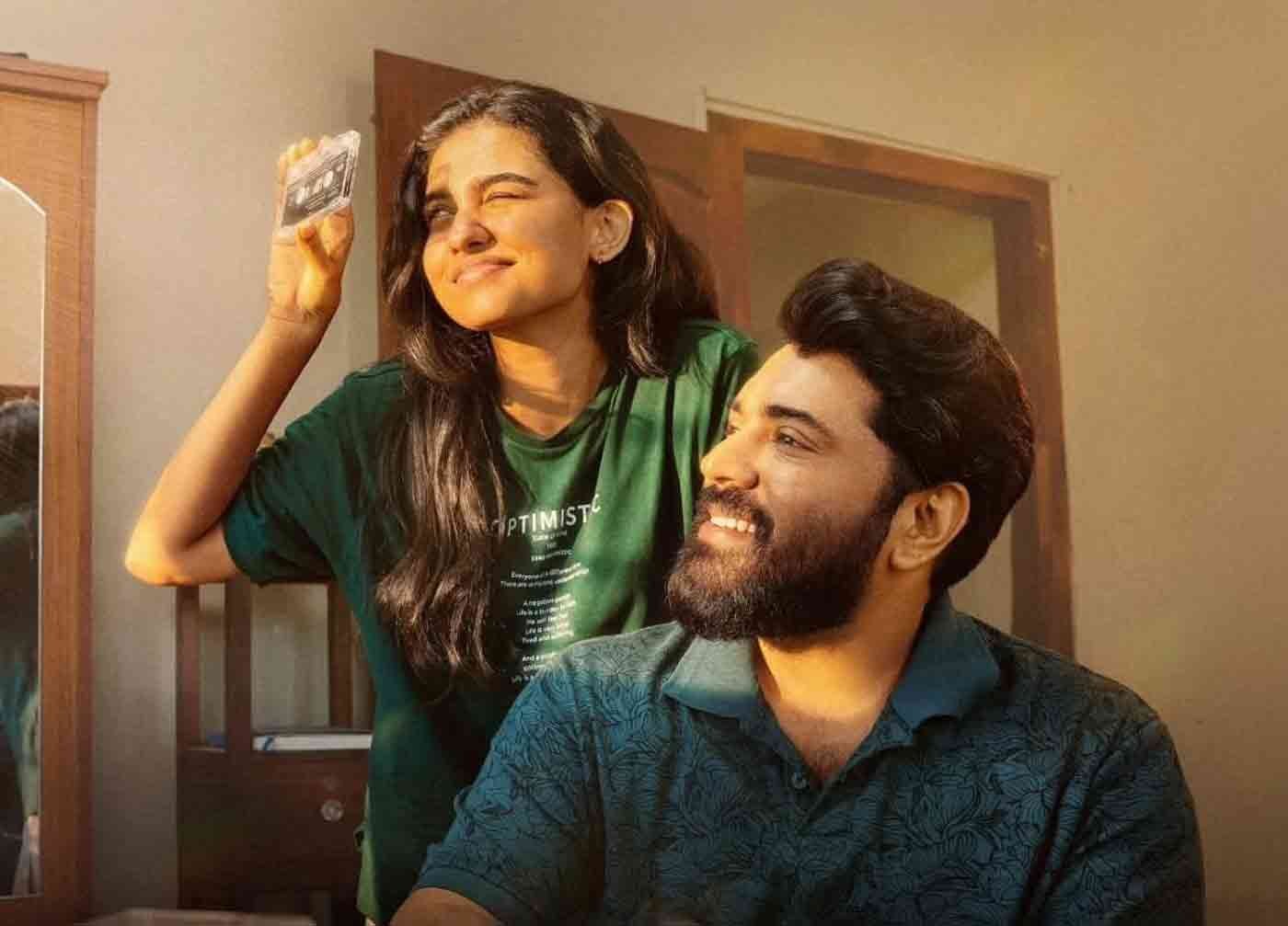
Moral policing becomes a crucial dimension of Bethlehem Kudumba Unit. Both brothers, Joel and Justin, are in love, with the women fully reciprocating their feelings. Yet, conservative families deny these women a voice or any agency. The men fight among themselves to claim dominance over her, reducing her to property that guards the honour of the house.
It is refreshing that the film, unlike the average rom-com, doesn’t romanticise these events to amp up the hero’s persona. These conflicts serve as a reflection of a community in which love stories between consenting adults cannot progress as they should. The film uses humour as a bridge to discuss social stigmas without letting the heaviness of the theme overpower its treatment.
The subdued heroism and vulnerability in the romance make Bethlehem Kudumba Unit the more likeable film of the two. There is no gloss camouflaging the premise, making the characters and their conundrums far more believable. Yet, one feels the film should have given the relationship more time to test its waters beyond the lens of societal judgment. How would a couple from different generations survive under the same roof for the rest of their lives?
Beyond the external circus
Surprisingly, 30 Weds 21, a popular, small-scale Telugu YouTube series with a smaller age gap between its protagonists (9 years apart), explored the mundane issues that crop up in such dynamics with greater interiority. Both Prudhvi (Chaitanya Rao Madadi) and Meghana (Ananya Sharma) belong to different generations and have contrasting pop-culture touchpoints, yet slowly find a way to appreciate each other’s differences.
The dynamic in 30 Weds 21 is intriguing because Prudhvi and Meghana are in an arranged marriage, leaving the latter quite apprehensive about their future. She isn’t instantly swooning over him; there are awkward silences between them. The guy is self-conscious about sounding like an oldie and struggles to communicate, while the girl takes time to figure him out as a person.
Furthermore, society doesn’t try to dictate how Prudhvi should communicate with Meghana; the issues lie entirely within himself. Unlike the commercial pressure associated with mainstream films that try to appease crowds as much as address core conflicts, 30 Weds 21 is far more forthcoming in tackling the elephant in the room with gentleness.
Still an unresolved question?
There is a reason cinema mirrors the society we live in. Back in 1975, K. Balachander’s Apoorva Ragangal constructed a deadlock featuring two age-gap relationships across two families (where a father and son fall for the daughter and mother of another family), concluding that there was no foreseeable future for them under the weight of societal judgment and personal apprehensions.
Cheeni Kum, shifting its backdrop to London, dealt with the age gap barrier with far greater wit (barring a melodramatic second hour and a weak subplot) than most recent titles. Amitabh Bachchan and Tabu, despite a 30-year difference, remain assured and at ease with each other. The conflict deepens naturally when Tabu’s father (played by Paresh Rawal) is six years younger than Amitabh’s character, all anchored by a classic Ilaiyaraaja soundtrack.
The ending of Bethlehem Kudumba Unit indicates that society has not progressed as much as we might hope; the stigmas around age-gap relationships simply persist in different forms. Justin and Ashley ultimately choose to settle in Ireland, where they can live on their own terms without constant scrutiny.
This raises a fundamental question: are we ready for a mainstream romance where an older woman falls for a younger man? The enduring fondness for Akshaye Khanna’s arc in Dil Chahta Hai proves the audience is open to it. Don’t those relationships deserve a happy ending, too? It’s a direction well worth exploring, but whether any mainstream filmmaker is ready to take that gamble remains to be seen.