

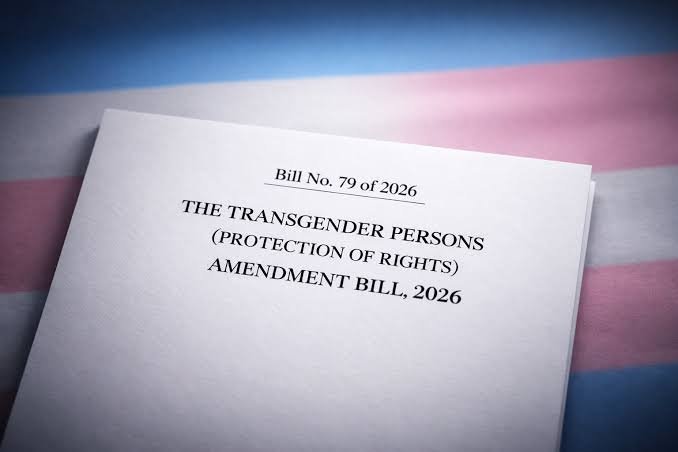
A contested amendment sparks nationwide debate as activists question legality, representation, and the future of transgender rights in India.

The passage of Transgender Persons (Protection of Rights) Amendment Bill, 2026, has ignited a wave of resistance across India, with activists, policymakers, and citizens divided. While the government frames it as reform, voices from within the transgender community call it restrictive, raising urgent questions on rights, representation, and lived realities.
A Bill Passed Amid Dissent
On March 25, 2026, the Lok Sabha passed the Transgender Persons (Protection of Rights) Amendment Bill through a voice vote, (A Procedure in Parliament, A voting method in deliberative assemblies, in which a group vote is taken on a topic or motion by responding vocally) even as opposition party members staged a walkout. The ruling government defended the move as a necessary update to existing legislation, but critics argue the process lacked deliberation and inclusivity.

Anish Gawande, one of India’s first openly gay political spokespersons, termed the day a “black day for human rights,” highlighting the absence of meaningful consultation with the transgender community. His remarks reflect a broader concern that the law was shaped without the voices it directly impacts.
What does the Amendment Seek to Change?

The amendment reportedly introduces stricter regulatory frameworks around identity certification, welfare eligibility, and institutional accountability. However, activists argue that these provisions risk reintroducing bureaucratic gatekeeping, undermining the self-identification principle upheld by the landmark NALSA v. Union of Indian Judgement.
India currently has over 18,000 registered transgender individuals (This information is sourced directly from the official government portal, Ministry of Social Justice and Empowerment, and managed by the National Portal for Transgender Persons) under official documentation systems. Activists estimate the actual number is significantly higher when including unregistered and marginalized LGBTQ+ identities. The bill’s implications extend beyond transgender persons to intersecting communities, including Dalit trans individuals, non-binary persons, and gender non-conforming groups.
Voices from the Ground
For Hyderabad-based activist and performance artist PatruniChidananda Sastry, the issue is deeply personal. Sastry bill not just as policy, but as a lived disruption.

Legislation like this shapes how society sees us, not just legally, but culturally, “Sastry observes. When identity becomes something that needs validation from authority, it strips away dignity. We are not asking for permission to exist.”
Their work in queer expression and community building reflects the anxieties many feel, particularly younger transgender individuals navigating identity in an already restrictive social environment.
Rural vs Urban Divide: Unequal Impact
The bill’s consequences are expected to vary sharply across geographies. In urban centres, where awareness and support systems are relatively stronger, individuals may still find ways to navigate institutional barriers. However, in rural India, where stigma remains deeply entrenched, sticker regulations could push transgender persons further into invisibility.
Access to documentation, healthcare, and employment is already limited. Additional layers of verification may deter individuals from seeking recognition altogether, reinforcing cycles of marginalisation.
Generational Concerns and Future Risks
The most vulnerable demographic remains transgender youth, particularly those aged between 16 and 30, who are in formative stages of identity assertion. For them, policy ambiguity translates into real-world consequences, ranging from denial of educational benefits to workplace discrimination.
Activists like Grace Banu and Akkai Padmashali have voiced fears that the bill could institutionalise exclusion rather than alleviate it. Their resistance underscores a broader anxiety: that progress achieved over the past decade could be reversed.
Legal and Political Road Ahead
Opposition leaders and activists are now pushing for the bill to be reviewed by a parliamentary standing committee. There is also growing discussion around challenging the law in the Supreme Court of India if it passes the Rajya Sabha.
Critics argue that any law affecting a historically marginalised community must be rooted in consultation, not expediency. The urgency to pass the bill, they say, risks eroding democratic processes.
Beyond Legislation: A Question of Inclusion
At its core, the debate is not just about legal clauses but about recognition of identity, autonomy, and dignity. The transgender amendment bill 2026 has become a flashpoint, exposing the gaps between policy intent and lived experience.
As Sastry poignantly puts it, “We are not resisting change, we are resisting being erased within it.”
From the talks with Patruni, he shares the challenges that we are gonna foresee are

Hyderabad-based trans-gender RTI activist Vyjayanti amplifies the voice for transgender rights, challenging discriminatory laws and defending constitutional guarantees of dignity, privacy, and equality. Vyjayanti signalled a legal challenge: “We do not accept this. We will test its constitutionality. Declared in our constitution,” she says.

In Conversation with Dr. Neeti, they shares, “Gender identity is deeply personal and cannot be dictated by a medical board that lacks both a scientific framework and a lived understanding. Imposing such structures undermines patient autonomy, a fundamental principle of healthcare, while ignoring the absence of clear medical protocols. With limited access to gender-affirming care and trained professionals, these regulations only deepen systemic barriers. Say no to Medical Board —what we need is respect for bodily autonomy.”
The coming weeks will determine whether this legislation evolves through dialogue or deepens the divide it has already created.
By Vaishnavi DR
For more such updates, please follow http://www.fridaywall.com