

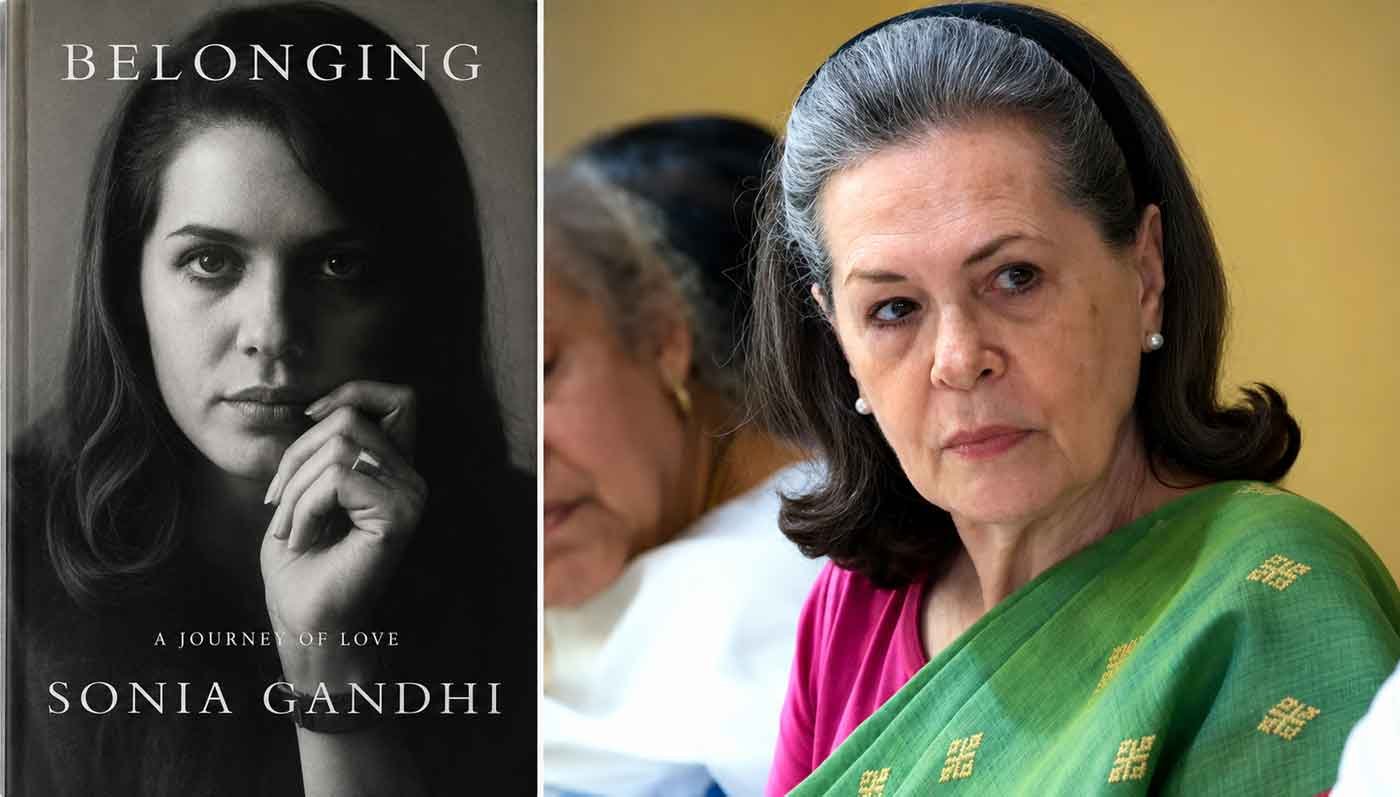
A memoir that has not yet reached readers has already generated a political storm.
Sonia Gandhi’s forthcoming Belonging: A Journey of Love is at the centre of a controversy involving Penguin Random House India, alleged demands for changes to portions concerning Prime Minister Narendra Modi, the RSS and China, accusations of political pressure, questions over freedom of expression — and now a counter from the BJP.
What began as a story about an Indian publishing deal that did not materialise has rapidly turned into a political argument over what was supposedly being edited, why it was being edited and whether those changes amounted to routine publishing scrutiny or something more.
Penguin Random House India has officially rejected one key interpretation of the episode. Congress leaders have questioned the publisher and alleged political pressure. The BJP has now turned Penguin’s reference to “fact-checking” back on Sonia Gandhi.
And the actual contents at the centre of the dispute remain unseen by the public.
## How the controversy began
The controversy erupted after The Indian Express reported that Penguin Random House India would not publish Belonging in India after Sonia Gandhi rejected proposed “editorial changes and deletions” to part of her manuscript.
The international edition of the memoir has been announced by Alfred A. Knopf, an imprint of Penguin Random House, for November 10, 2026.
The Indian Express subsequently reported that the disputed portions concerned references to Modi, the RSS and China.
But that claim requires an important qualification.
Former Rajasthan Chief Minister Ashok Gehlot, who has been among the most vocal Congress leaders on the controversy, told The Indian Express that the “main thing” sought to be edited or removed concerned China, Modi and the RSS.
However, when the newspaper asked him how he knew this, Gehlot said that this was what he had heard and what was being discussed within the party. He acknowledged that he had neither read the manuscript nor spoken to Sonia Gandhi about it.
That distinction is important because the specific contents of the proposed edits have not been made public.
Penguin India issues an official statement
As the original report gathered attention, Penguin Random House India issued an official clarification.
It categorically stated that it is not the publisher of Belonging in India.
More significantly, it disputed the suggestion that it had decided not to publish the memoir because Sonia Gandhi refused its editorial changes, saying such an interpretation did not accurately represent the circumstances.
At the same time, Penguin confirmed that discussions had taken place.
The publisher said fact-checking and providing recommendations to authors were both its prerogative and responsibility and described them as a normal part of publishing.
It also said that throughout the relevant discussions it had remained “willing and keen” to publish the memoir.
Penguin declined to reveal what had been discussed with Sonia Gandhi, citing the confidentiality of author-publisher negotiations.
The statement therefore clarified one part of the story while leaving another unanswered: if Penguin remained willing to publish the book, why did the arrangement ultimately not happen?
Congress alleges pressure
Penguin’s clarification did little to end the controversy.
Instead, several Congress leaders took the issue to social media and turned it into a wider argument about censorship and freedom of expression.
Ashok Gehlot alleged that pressure had been exerted on Penguin India to remove portions dealing with Modi, the RSS and what he described as the occupation of Indian territory by China during the Modi government’s tenure.
He questioned why material that could be published internationally should allegedly require alteration for publication in India and described suppression of the book under pressure as an attack on freedom of expression.
Former Madhya Pradesh Chief Minister Kamal Nath also questioned whether the publisher was acting independently or under pressure and described the controversy as a matter of serious concern for freedom of expression.
Congress MP and Deputy Leader in the Lok Sabha Gaurav Gogoi called Penguin India’s statement “weak”. Pointing to Penguin’s publication of Narendra Modi’s Exam Warriors and books concerning the RSS, he alleged that people within the BJP government were afraid of Sonia Gandhi’s book being read in India.
The rhetoric became sharper on Congress-affiliated social-media accounts.
Indian Youth Congress questioned Penguin over exactly what changes it had sought and why, while also posting the satirical description “Penguin Janta Party”.
Congress Seva Dal posted “Paltu Penguin”.
Mahila Congress president Alka Lamba accused Penguin and PRHI of using pressure tactics, while the Kerala Congress account declared that nothing could stop Belonging from reaching readers.
The reactions transformed what could have remained an industry dispute over publishing rights into a full-fledged political controversy online.
The BJP responds — with a question of its own
The BJP has now responded, but interestingly, its argument focuses on Penguin’s own use of the term “fact-check”.
BJP leader Amit Malviya questioned why a publisher would need to fact-check a memoir written by the person whose life it chronicles.
Referring to Penguin’s statement that fact-checking was a normal publishing responsibility, Malviya asked what exactly required checking — Sonia Gandhi’s memories or, as he put it, the line between “fact and fiction”.
The response turns the Congress argument on its head.
While Congress leaders are asking why politically sensitive portions of the memoir allegedly required changes, the BJP is asking why Penguin apparently believed portions of the manuscript required fact-checking in the first place.
No official evidence has so far emerged establishing that the Union government directed Penguin to make changes to the manuscript.
The allegations of government pressure therefore remain allegations.
And then social media took over
Beyond statements from political leaders, the controversy has generated considerable discussion across X, Facebook and other social platforms.
Posts and conversations have ranged from serious concerns over freedom of expression and editorial independence to satire about Penguin, political censorship and the unintended publicity the controversy could generate for the memoir.
Some users have questioned whether a memoir — by definition an author’s recollection and interpretation of events — should be subjected to the same standards of fact-checking as a work of reportage.
Others have pointed out that memoirs involving living political figures, geopolitical disputes or potentially contested factual assertions routinely involve extensive legal and editorial scrutiny.
And another argument has emerged: if controversial passages do eventually appear unchanged in an international edition, readers will inevitably compare editions and ask whether anything is different in India.
That possibility alone has amplified curiosity around a book still months away from publication.
What Sonia Gandhi herself has said about the book
While the political controversy has generated statements from Penguin, Congress leaders and the BJP, Sonia Gandhi’s publicly released comments about Belonging have focused on why she wrote it rather than on the current publishing dispute.
In the statement accompanying Knopf’s announcement of the memoir, Gandhi said much had been written about her family but few accounts had reached the truth of their motivations, actions and “very human failings”.
She described the book partly as a homage to that humanness and said her story would offer her perspective on the social and political transformations she has witnessed during six decades in India.
The memoir traces her journey from childhood in post-war Italy and her relationship with Rajiv Gandhi to life in the Nehru-Gandhi family, devastating personal losses and her eventual entry into Indian politics.
The international edition is scheduled for November 10, 2026.
The questions that remain
For all the statements, posts and political accusations, several basic questions remain unanswered.
What exactly did Penguin want changed?
Were the proposed changes primarily routine editorial and legal fact-checking, as Penguin’s statement suggests?
Did they specifically concern Modi, the RSS and China, as Congress leaders allege?
Why did the publishing arrangement fail if Penguin says it remained willing to publish the memoir?
And was there any external political pressure?
At present, there is no publicly available evidence proving the last allegation.
There is also no publicly released version of the manuscript or Penguin’s proposed edits that would allow an independent comparison.
That is what makes the controversy around Belonging particularly unusual.
One side is talking about freedom of expression. Another is asking what needed fact-checking. The publisher insists editorial scrutiny is simply part of publishing while refusing, understandably, to disclose confidential negotiations.
And somewhere between those competing versions is a manuscript readers haven’t yet seen.
Perhaps the greatest irony is that a dispute ostensibly about what should or should not appear in Sonia Gandhi’s memoir has ensured considerably more people now want to know exactly what is in it.