
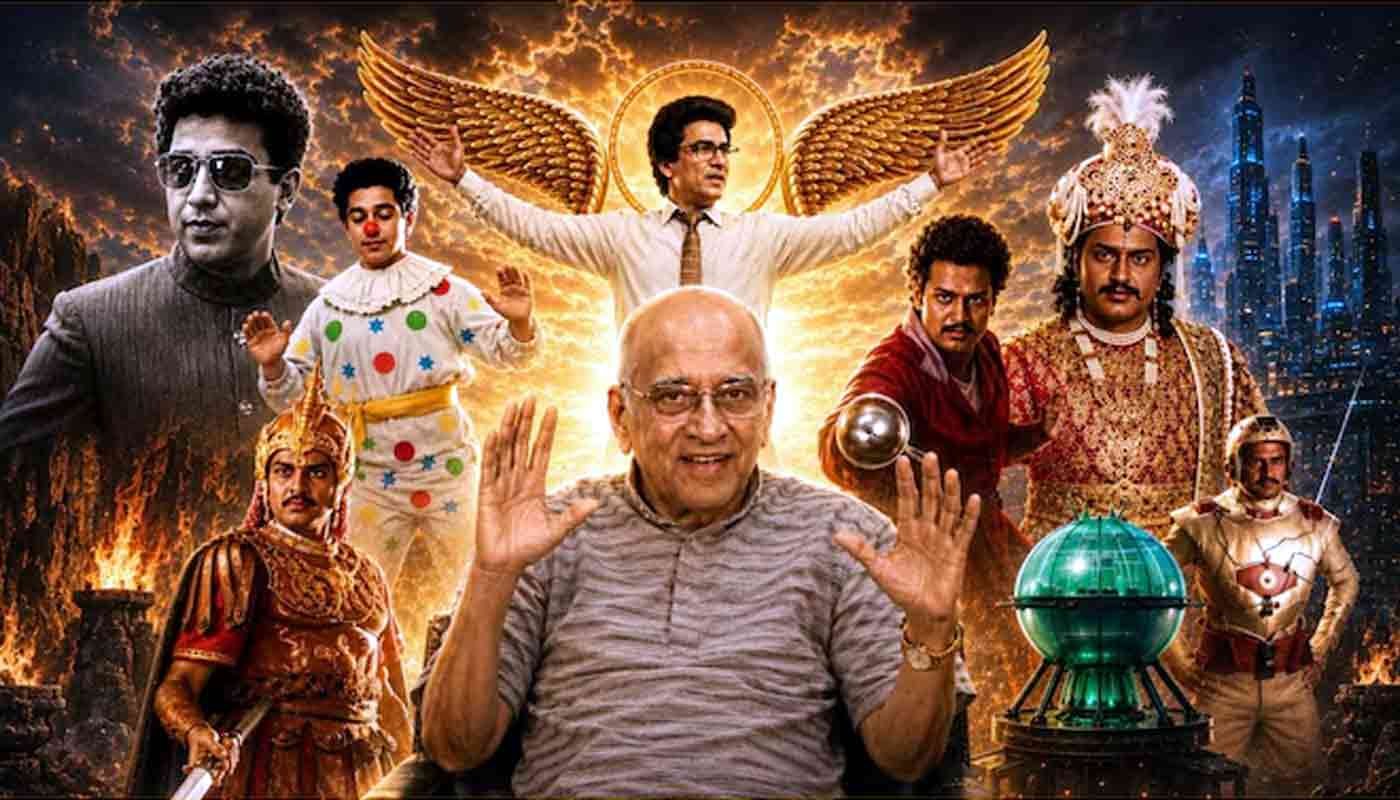
What kept Singeetham Sreenivasa Rao looking towards tomorrow? From a classroom lesson in communication to the dialogue-free Pushpaka Vimanam and the time-travelling Aditya 369, his journey offers revealing glimpses of how an extraordinary cinematic mind worked. Aruna Ravikumar reflects on the experiences, musicality, humour and enduring optimism that shaped a filmmaker who never stopped imagining.
The passing of Singeetham Sreenivasa Rao marks the end of an extraordinary chapter in Indian cinema. His innovation, imagination and inspiration coupled with musicality and humour, led to a unique body of work that spanned over six decades and 60 films leaving an indelible impression on lovers of cinema. To speak of Singeetham Sreenivasa Rao merely as a film director would be to describe only one facet of an extraordinarily versatile film personality. He was a writer, a playwright, an actor, a musician and even a painter. Each of these creative pursuits enriched the others ultimately converging in the director he became—a filmmaker of extraordinary vision, imagination and individuality.
There is a revealing story from the beginning of his life that, in retrospect seems almost like a lesson for the film maker he would become. Before entering the film world as an assistant to the legendary film maker K.V. Reddy, Singeetham spent a year as a teacher. When he first walked into the classroom he brought with him a level of knowledge that his headmaster- father felt was more suitable to college students than school children. His father gave him some profound advice: before entering the actual classroom, he was asked to practice teaching an imaginary class of children in the school backyard. The real lesson was not about teaching. It was about communication.
What mattered was not how much the teacher knew or how impressively he could explain it, but how well the students understood what he wanted to convey. That insight was one of the earliest foundations of the remarkable film- maker with the rare ability to translate his imagination into an unforgettable experience for the viewer. And imagination he had in abundance, where he moved effortlessly between genres and languages, between the playful and the profound, between music and visual invention. His love for music was inherited from his mother who was a violinist well- versed in both Carnatic and western violin. In his film Michael, Madan, Kamaraj, the director as narrator, appears on screen and sings the introductory song set to music by the maestro Ilayaraja.
Singeetham Sreenivasa Rao spent 17 years working as an assistant director with the legendary film maker K. V. Reddy, a towering figure who commanded immense respect and was known for his discipline and exacting standards. He became a guru and mentor who taught him the grammar and craft of cinema. Singeetham worked on such iconic films as Mayabazaar, Pellinaati pramaanaalu and Srikrishnarjuna Yuddham assisting Reddy and in association with eminent dialogue wrier Pingali Nagendra Rao. From these two experts, he learnt the fundamentals that would become the foundation of his own directorial language- screenplay, scene reconstruction, composition and the technical reconstruction of an idea. But what makes his apprenticeship most fascinating is the fact that he did not merely learn the established rules of film making. He learnt to question them. Mayabazaar was a formative experience. Watching the brilliant performances of Savitri as Sashirekha and S. V. Ranga Rao as Ghatotkacha and seeing how the film transformed their characters and identities through visual story- telling, gave the young Singeethan an education beyond textbooks. The scenes in which Ghatotkacha assumes Sashirekha’s form demonstrated the immense possibilities of cinema- the ability to make the impossible appear completely believable through performance, visualisation and technique.
Years later, another conversation from his days with K. V. Reddy would return to him in a completely different form. During the shooting of one of Reddy’s films, there was a discussion between the director and Pingali Nagendra Rao about dialogue. A line had been written about ‘being in darkness’ even though the visual itself did not support that idea. When Reddy questioned this, the explanation was that dialogue was powerful enough to convey an idea even when the visual did not. For Singeetham, the observation planted a seed. Could the reverse also be true? Could a film communicate everything through its images, music and sound effects, without any dialogues?
This question remained with him for years and eventually he answered it with his film Pushpaka Vimanam. Starring Kamal Hassan and Amala in the lead roles, Pushpaka Vimanam was a bold experiment: a feature film without spoken dialogue in which the story was conveyed in a gripping manner through visuals, performances, background music and sound effects. What might have seemed impossible became a hugely successful trendsetting film. He had taken something he had observed as an apprentice and decades later, transformed it into an entirely original cinematic language. Pushpaka Vimanam went on to earn a place not only in Indian cinema but was recognised as one of the 100 great films in world cinema. An incredible honour to a creative mind that went on to receive several awards and encomiums.
Another shining example of his genius was the unforgettable film about time travel’ Aditya 369 which showcased the astonishing breadth of his imagination. The film took on the unusual theme of time travel and made it the basis for a hugely entertaining mainstream film. Nandamuri Balakrishna played the protagonist who travels across time, taking the audience into the world of the powerful king Krishnadevaraya as well as into the future. Moving between history and science fiction with ease, it remains one of the most distinctive films made by him where an unconventional idea appealed to a wide audience. That ability to dream differently without losing the audiences, was perhaps one of Singeetham’s greatest gifts.
Another remarkable experiment was Vichitra Sodarulu in which Kamal Haasan played a dual role where one of them was a dwarf. This was a visual challenge but Singeetham approached it with ingenuity and playfulness that marked so much of his work. The scenes involving the dwarf came with remarkable visual expertise where the solution came not from a celebrated technician or an elaborate piece of technology but from an unexpected source- a set boy named Japan. The suggestion was to place shoes on the actor’s knees creating an illusion that the character was much shorter than he actually was. The result was another super successful trail blazing film that re-defined cinema.
Mayuri, a film that followed the real life incident of a dancer who lost her foot in an accident, had an artificial foot fitted and resumed dancing had the real -life victim Sudha Chandran play herself, winning hearts and instantly catapulting her to stardom. It was a film that portrayed human tragedy that was overcome with great and determination giving hope and positivity to all those who watched it. Singeetham Srinivasa Rao was a director who made many unforgettable films including Samskara, Bhairava dweepam, Sommokkadidi- Sokokadidi, Pantulammma, America Ammayi and many more, each of which defined his craft as an innovative film maker whose presentation was unique and heart- warming.
An admirable quality that director had was his ability to take both bouquets and brickbats in his stride. He once said and I quote “When someone is angry and hurling abuses at me, I don’t hear his words but watch the way his eyebrows move, his breath becomes heavy and he fumbles while speaking and I begin to laugh”. How many of us can do this in the face of negativity?
For all his grounding in tradition and his long apprenticeship under K.V. Reddy, Singeetham Srenivasa Rao was never a film maker who lived in the past or believed that the past was necessarily more glorious than the present. He was at heart, a man of the future. He seemed to draw his energy from the creative process itself-the struggle with an idea, the mental blocks, the sudden midnight flashes when a solution would arrive and the excitement of discovering something not thought of before. For him creativity was not a destination it was a journey.
He believed instinctively in tomorrow which he felt would be better than today and that the day after would be better than tomorrow. That optimism was reflected in his cinema. He was always looking ahead, imagining possibilities that had not yet become reality. Long before many of them became commonplace he would visualise satellite screens and new forms of communication. His imagination seemed to live a little ahead of its time and was perhaps the reason why age seemed irrelevant to him. Singeetham Sreenivasa Rao once said, he never looked at his watch while working. When an idea was taking shape time was not to be counted but forgotten.
That passion remained undiminished even at an age when most people stepped away from creative work. His final film Sing Geetham, is perhaps the most moving testament to that spirit. The title itself carries a personal resonance. Singeetham echoes his family name, while Sing Geetham means “sing songs’. But behind the title lay a dream he had nurtured for nearly forty years. At the age of 94, Singeetham brought Sing Geetham to the screen. The musical fantasy drama project talked about reinforcing the need to live in harmony with nature and won critical acclaim for its freshness and magical presentation. It was a fitting final chapter- not because it marked an ending but because it embodied everything that defined him. The curiosity. The imagination. The music and the persistence. The refusal to believe that creativity has a shelf life.
Singeetham Sreenivasa Rao spent a lifetime looking forward.
Even at 94, he was still dreaming of a glorious tomorrow.
ARUNA RAVIKUMAR