

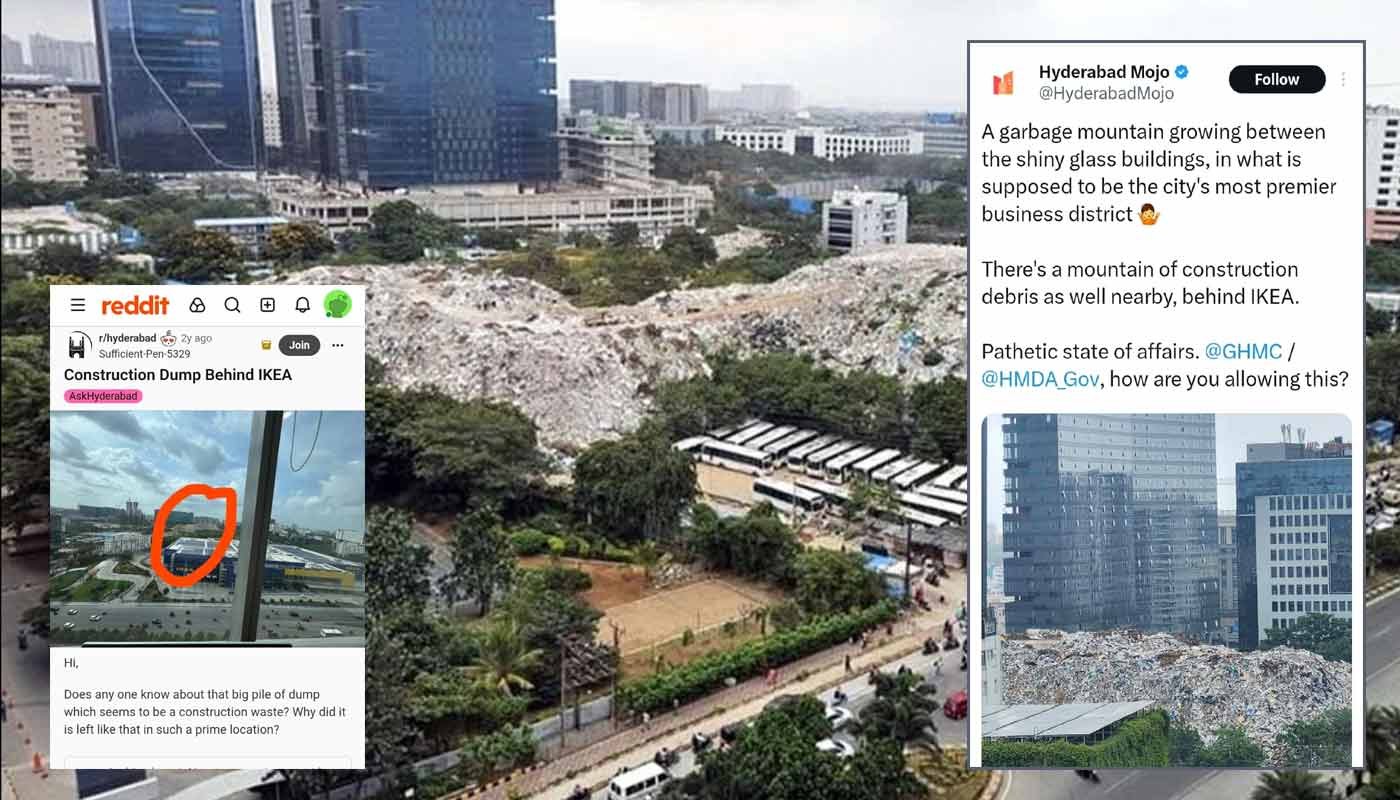
On the road leading into Hyderabad’s glittering IT corridor near IKEA in Gachibowli, the city’s futuristic image suddenly fractures. Sleek office towers, tech parks and premium real estate projects abruptly give way to something that looks almost dystopian — towering mountains of construction debris.
What began as dumped excavation soil and construction waste has now evolved into one of Hyderabad’s most visible urban scars. The debris heaps near the Shilpa Layout flyover and surrounding stretches have grown so massive that commuters often compare them to six- or seven-storey buildings. For thousands travelling daily through Gachibowli, Financial District and Mindspace, these “garbage mountains” have become an unavoidable part of the landscape.
And despite growing outrage, the reality is this: the heaps are unlikely to disappear anytime soon.
A Crisis Years in the Making
The dumping issue around Gachibowli and the IKEA corridor has been building quietly for years alongside Hyderabad’s explosive real-estate boom. Massive excavation works for cellars, flyovers, commercial towers and luxury housing projects generated enormous quantities of soil, rocks and construction-and-demolition (C&D) waste.
Instead of being scientifically processed from the beginning, large quantities were allegedly dumped on vacant stretches and roadside pockets near the IT corridor. Over time, the piles expanded into artificial hills visible even from elevated roads and flyovers.
The situation worsened as additional waste — including broken concrete, discarded furniture, plastics and mixed garbage — reportedly began getting added to some stretches. Residents and commuters have repeatedly complained about:
* Dust pollution
* Reduced road aesthetics in Hyderabad’s premium business district
* Air quality concerns
* Unsafe dumping practices
* Traffic distractions
* Environmental impact on nearby areas
Social media outrage has only intensified in recent months, with drone videos and commuter footage repeatedly going viral.
Reddit users in Hyderabad have called the area “Hyderabad’s garbage mountains,” while others pointed out that Google image searches for Gachibowli now prominently show the debris heaps.
Why The Debris Cannot Be Cleared Quickly
At first glance, the solution appears simple: remove the debris.
But officials and urban experts say the reality is far more complicated.
The Scale Is Enormous
The volume of debris is massive. Clearing it requires:
* Hundreds or thousands of truck trips
* Large-scale excavation equipment
* Traffic management planning
* Designated dumping or recycling sites
* Environmental clearances in some cases
Transporting such quantities alone could take months.
Officials are reportedly considering two approaches:
* Transporting debris to authorised C&D processing plants
* Processing and recycling portions of the waste on-site itself
Both options come with logistical and financial complications.
Ownership And Accountability Issues
One of the biggest hurdles is determining:
* Who originally dumped the debris
* Which portions belong to which project or contractor
* Whether some land parcels are under private ownership
* Which agency bears financial responsibility for removal
Urban infrastructure projects in the corridor involve multiple public and private stakeholders, making accountability extremely fragmented.
This legal and administrative complexity is one reason the issue has dragged on for years.
Recycling Construction Waste Is Slow And Expensive
Unlike ordinary garbage, C&D waste requires specialised handling.
Concrete, soil, rocks and excavation material must often be:
* Segregated
* Crushed
* Processed
* Reused in roadwork or construction
* Transported to authorised facilities
Large-scale recycling infrastructure itself remains limited compared to Hyderabad’s construction explosion.
Experts point out that scientific disposal of construction debris is expensive, and agencies often hesitate unless strict enforcement mechanisms exist.
Cyberabad Municipal Corporation’s Recent Response
The issue has recently drawn the attention of the newly formed Cyberabad Municipal Corporation (CMC), which now oversees the rapidly expanding IT corridor region following the trifurcation of GHMC earlier this year.
Cyberabad Municipal Commissioner G Srijana inspected the debris sites along with officials from multiple departments, including pollution-control authorities and waste-management agencies.
According to reports, officials acknowledged the seriousness of the issue but also expressed reservations about immediate removal because of:
* The scale of the debris
* Processing challenges
* Environmental considerations
* Transport logistics
* Cost implications
Authorities stated they are still exploring the “best possible solution.” (Deccan Chronicle)
Irony In Hyderabad’s Fastest Growing Corridor
The debris mountains now sit in the middle of one of India’s fastest-growing urban corridors — a region marketed globally as Hyderabad’s innovation and technology hub.
The same roads connect:
* Global tech offices
* Luxury residential towers
* International schools
* Premium malls
* High-end hospitality projects
Yet daily commuters travelling toward IKEA, Financial District and Gachibowli are confronted by giant mounds of dust and debris that symbolise the darker side of hyper-growth.
The contradiction has increasingly become a talking point online.
Officials Tighten Construction Waste Rules
Even as the existing heaps remain unresolved, Cyberabad authorities have begun cracking down on future violations.
Commissioner G Srijana recently directed builders and real-estate developers to:
* Follow environmental norms
* Control dust pollution
* Ensure proper disposal of construction waste
* Hand over debris only to authorised agencies (Telangana Today)
The move signals growing concern within civic authorities about the environmental impact of unchecked urban expansion.
Can Hyderabad Truly Solve This?
The larger question extends beyond one debris hill.
Hyderabad’s western corridor is witnessing unprecedented construction activity:
* Flyovers
* Metro expansion proposals
* IT parks
* High-rise residential towers
* Commercial mega-projects
Without strong enforcement, dedicated C&D recycling systems and long-term waste-management planning, experts warn similar dumping crises could emerge elsewhere across the city.
For now, commuters travelling toward Gachibowli and IKEA may continue seeing the debris mountains for months — possibly longer.
Because this is no longer just a cleanliness issue.
It is a collision between rapid urbanisation, governance gaps, environmental accountability and the hidden cost of building a global city at breakneck speed.