
Literature Festival Is Not a Book Fair – Literature festivals thrive despite modest book sales? Explore the difference and why live conversations matter with AL Sharada
The recent Guardian article on literature festivals in India seems to confuse a literature festival with a book fair. The two are very different.
A book fair is all about books. It is about readers discovering books, publishers showcasing their titles, and people going home with bags full of books. Yes, there are book launches, panel discussions , author interactions and cultural programmes. But people don’t go to a book fair exclusively for these events. They go to browse hundreds of titles, pick up books they have always wanted to read, discover new ones and enjoy the pleasure of buying books, often at discounted prices.
I still remember finding a collection of Sharath Chandra Chattopadhyay’s books at a book fair. I immediately picked up Sesha Prashna, a novel I had read in my teens and wanted to read again. Ironically, I still haven’t read it. It sits prettily on my bookshelf and every time I look at it, it brings back memories of that book fair. Sometimes, just owning a book you have longed for gives immense pleasure.
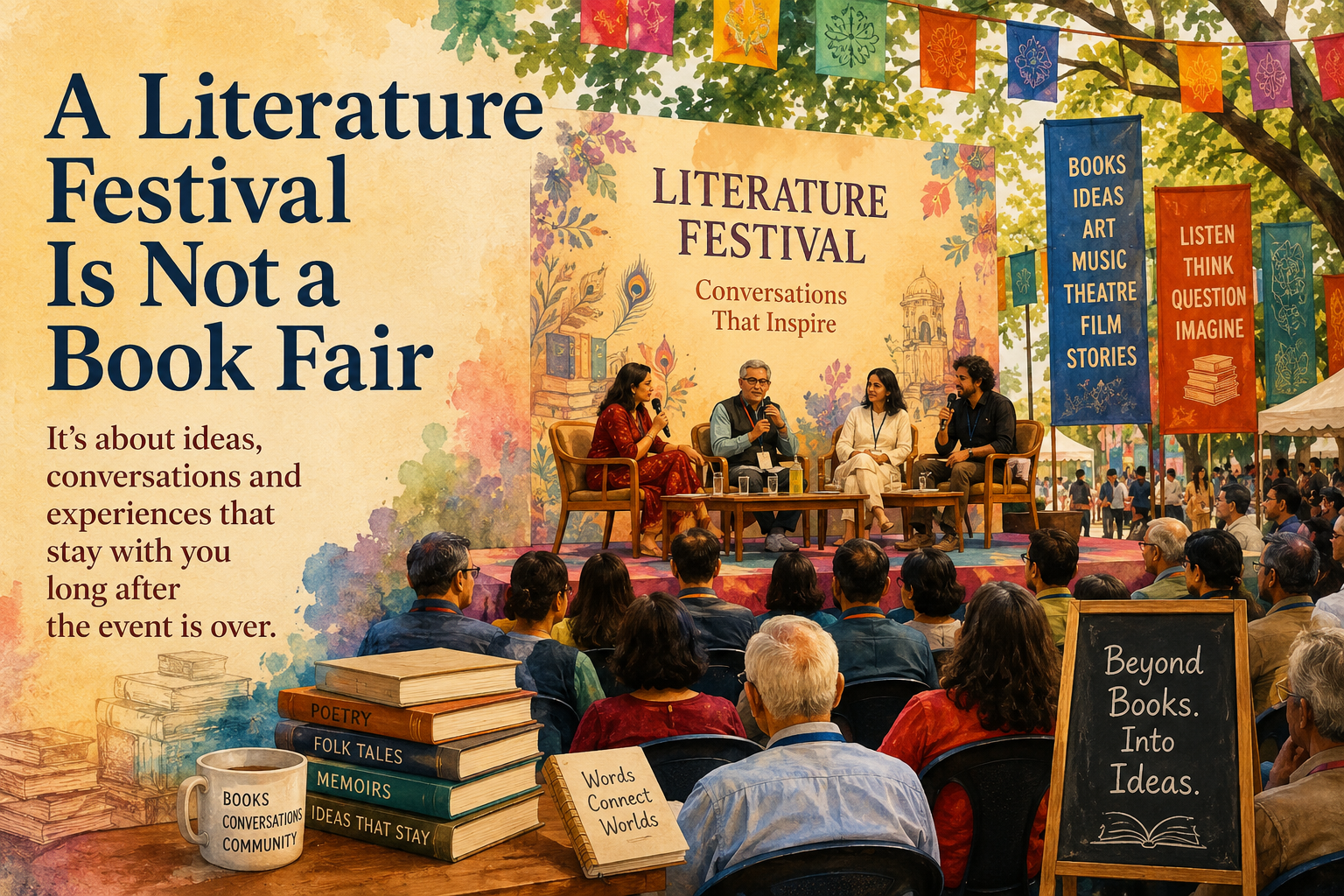
The difference becomes evident the moment you enter the two events. At a book fair, the book stalls take centre stage, while the cultural programmes occupy a small corner. At a literature festival, it is the other way round. The book-selling section is usually just a small part of the venue, while the conversations, performances and discussions form the heart of the festival. That, in itself, tells us where the focus of the two events lies.
A literature festival is all about literature, but not about book sales. It is about the craft, the ideas, the thoughts and the conversations. The riveting conversations, the heated discussions and the insights are what draw audiences to literature festivals. They provide people with an opportunity to see and interact with their favourite authors, listen to their favourite speakers talk about issues that matter, and, for once, move away from their mundane world and explore the rarefied world of storytelling, creativity and imagination.
At literature festivals, literature is not limited to books, and certainly not just to English publications. Storytelling happens through music, theatre, dance, cinema, documentaries and folk art. They all form an integral part of the curation of a literature festival. Perhaps that is why literature festivals appeal even to people who may not consider themselves regular readers.
I remember watching a documentary on Vinjamuri Anasuya at the Hyderabad Literature Festival. She contributed immensely to preserving and promoting Telugu folk music. Having grown up listening to her songs, it was a wonderful opportunity to learn about her journey.
Could I have found the documentary online and watched it at home? Of course. But watching it on a big screen, with her daughter, who had made the film, sharing her experiences afterwards, and with fifty others in the audience who were equally passionate about her work, was an entirely different experience. That is what literature festivals offer: an immersive experience that cannot be replicated on a screen.
For me, literature festivals are also very personal. I particularly enjoy attending sessions where Laadli Award winners, jury members and my friends are speaking. Watching people I know and admire share their work and ideas with an audience is always a special experience.
And by the way, who would not want to listen to Shashi Tharoor or Vidya Balan speak? Or watch Arnab Goswami create a stir in the audience? Or hear Jerry Pinto regale listeners with his stories? The experience of being part of a live event is very different from watching the same event on a screen. I think that is what draws people to literature festivals. It is not snobbery or duplicity. It is the joy of being part of a live conversation.
To see a literature festival simply as a place to sell books is to miss its true purpose. It is about the craft, the ideas, the thoughts and the conversations. That is what draws people to literature festivals.
Perhaps the question is not why India has so many literature festivals despite modest book sales. The better question is why we should expect literature festivals to justify their existence through book sales at all.
AL Sharada is the Director of Population First, a non-profit organisation focused on population and gender issues. She is the founder of Laadli, a premier advocacy initiative and media campaign designed to promote gender sensitivity in journalism and advertising.