

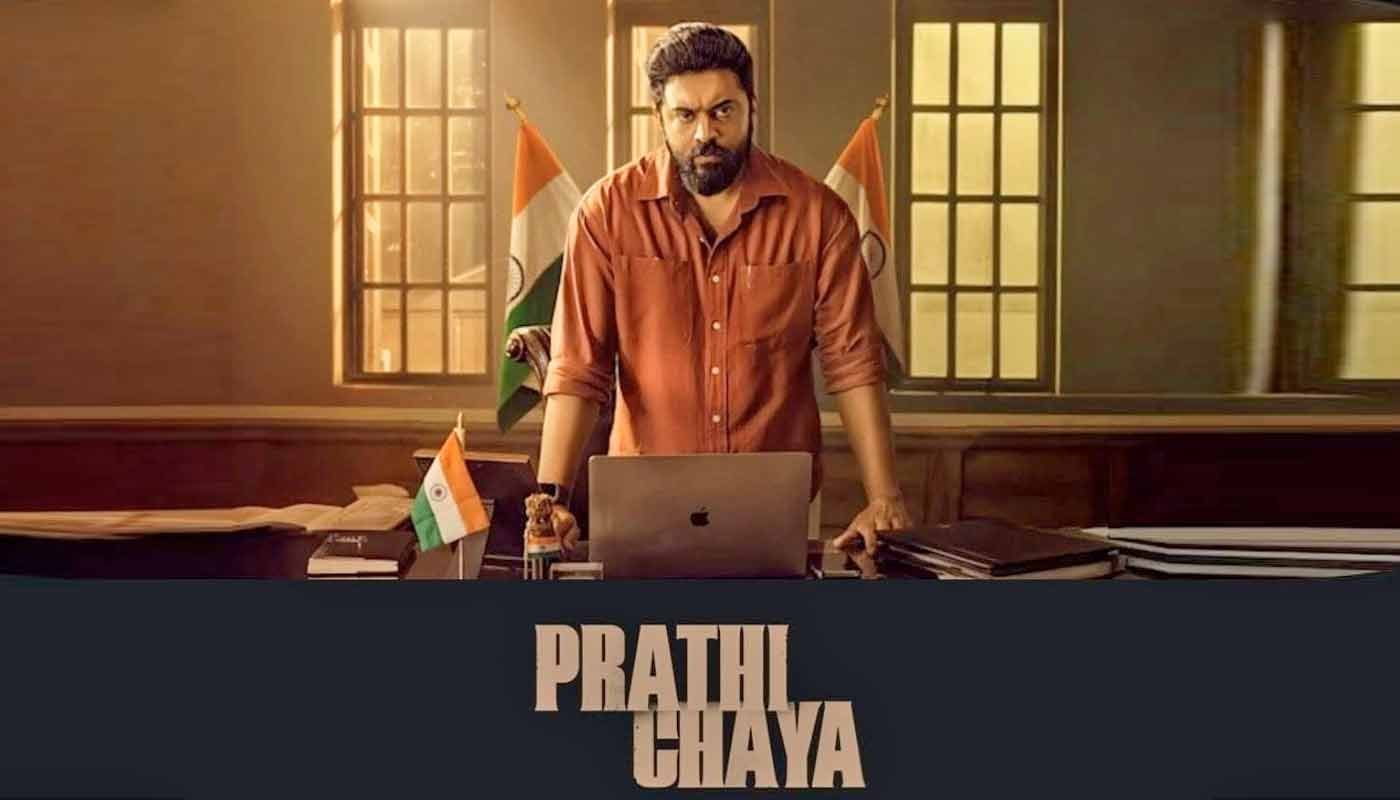
Introduction: Despite a timely premise about politics and media manipulation, Prathichaya ends up as a predictable and uninspired thriller that fails to offer anything new.
Prathichaya review by Kausalya Rachavelpula
Prathichaya, starring Nivin Pauly and directed by B. Unnikrishnan, attempts to position itself as a gripping political thriller rooted in media manipulation, corruption, and power struggles. On paper, the premise sounds timely and relevant: a tech-savvy son steps in to salvage his politician father’s damaged reputation amidst scandal. However, what unfolds on screen is far less compelling, a film that leans heavily on outdated tropes and struggles to justify its own seriousness.
At its core, the film revolves around themes of political image-making and the fragile nature of public perception. While this is an interesting starting point, the narrative quickly falls into a pattern of clichés. Instead of offering nuanced insights into the intersection of politics and media, the story recycles familiar plot devices, corruption scandals, power-hungry rivals, and dramatic revelations, that feel more like echoes of older Malayalam political dramas than a fresh take. Critics have similarly noted that the film is weighed down by “predictable plotting” and dated storytelling choices .
One of the film’s biggest shortcomings lies in its screenplay. The writing attempts to appear complex, weaving together elements like corporate influence, data control, and political conspiracies. However, these ideas rarely cohere into a satisfying whole. Instead, they feel scattered and underdeveloped, giving the impression of a film that wants to say a lot but ends up saying very little. Even when the narrative introduces potentially engaging conflicts, it fails to build tension effectively, often resolving them in overly convenient or unconvincing ways.
The pacing further compounds these issues. Much of the film unfolds at a sluggish tempo, demanding patience from the audience without delivering a commensurate payoff. Several reviews point out that the film requires significant investment from viewers but offers minimal emotional or intellectual reward in return . This imbalance makes the experience feel unnecessarily stretched, as though the film confuses length with depth.
Performance-wise, Nivin Pauly delivers a restrained and competent act, but even his presence cannot fully elevate the material. His character, though central to the narrative, lacks the depth needed to make his journey engaging. The emotional stakes remain shallow, and his motivations often feel underexplored. Supporting performances are similarly uneven, with some characters reduced to mere plot devices rather than fully realized individuals.
Visually, the film maintains a polished look, and certain sequences hint at the director’s intent to create a tense, atmospheric thriller. However, these technical strengths are undermined by the lack of narrative urgency. The film occasionally shows flashes of what it could have been, a sharper, more focused exploration of political manipulation, but these moments are too few and far between.
Another critical issue is the film’s reliance on stereotypes. Instead of challenging conventions or offering new perspectives, it falls back on familiar character archetypes and predictable story arcs. This results in a viewing experience that feels not only repetitive but also uninspired. As some viewers commented the film resembles “old wine in a new bottle,” where contemporary themes are layered onto a fundamentally outdated storytelling framework .
Ultimately, Prathichaya is a film with ambition but little originality. It tries to tackle important subjects like media influence and political power but does so in a way that lacks freshness and narrative cohesion. While it may appeal to viewers who enjoy conventional political dramas, those expecting a sharp, thought-provoking thriller are likely to be disappointed.
In the end, the film stands as a reminder that strong themes alone are not enough, without compelling storytelling and genuine innovation, even the most relevant ideas can feel stale.