
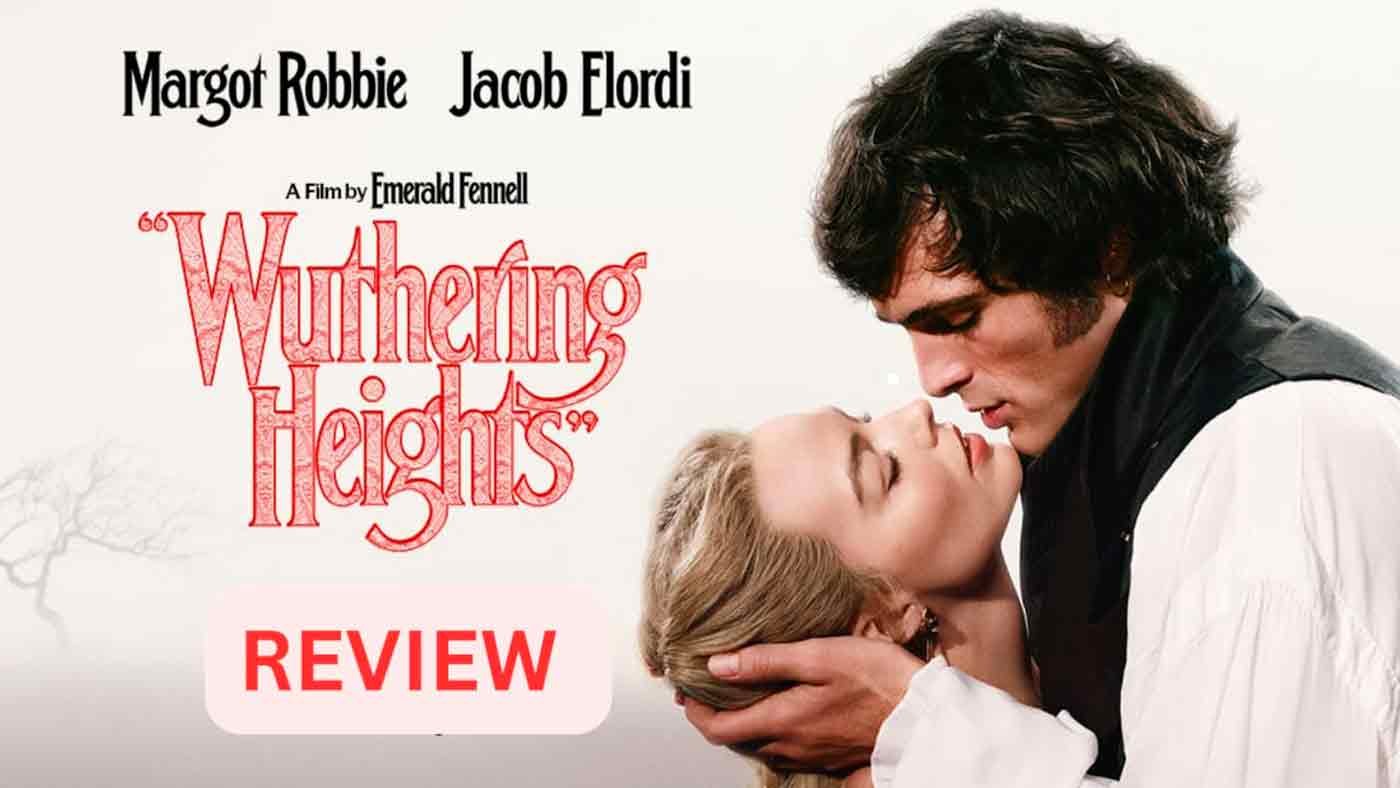
The 2026 adaptation of Wuthering Heights delivers impressive visuals but struggles to balance gothic tragedy with its divisive creative choices.
Wuthering Heights (2026) review by Kausalya Rachavelpula
Emily Brontë’s Wuthering Heights has always been a dark, unsettling story about obsession, revenge, and destructive love. It’s never been a conventional romance, and that’s exactly what makes it such a memorable classic. Every adaptation has to find a balance between preserving the novel’s gothic tragedy and bringing something fresh to the screen. Unfortunately, the 2026 adaptation leans so heavily into shock value that it loses much of what made the original story emotionally compelling.
The sexual themes feel relentless, almost like they’re attacking the audience throughout the film. Instead of adding anything meaningful to the story, they become repetitive and genuinely gross. The film repeatedly pushes uncomfortable intimacy and coercive moments to the forefront, making them feel more important than the emotional conflict between the characters. Rather than building tension, these scenes eventually become exhausting. It’s hard to remember another period drama that felt this uncomfortable to sit through.
Then it’s the same old “women fighting over a boy” nonsense. Catherine and Isabella are once again reduced to revolving around Heathcliff, instead of being allowed to exist as fully realized characters with their own emotional journeys. Even worse, the movie seems strangely fascinated with coercive sexual dynamics. Catherine keeps resisting Heathcliff, yet he never stops pursuing her. The film repeatedly returns to this pattern, blurring the line between obsession and romance in a way that feels deeply uncomfortable. When they were children, their relationship felt completely different, built on companionship and mutual understanding. As adults, that connection is replaced with something that feels unsettling rather than tragic. It leaves you wondering what exactly the film is trying to romanticize.
The film also has an odd obsession with glamorising women crying. Nearly every emotional breakdown is framed with lingering shots and dramatic visuals, as though suffering itself is supposed to be beautiful. Instead of making these scenes more emotional, they become repetitive. Watching women cry over and over again doesn’t strengthen the story, it simply makes their pain feel aestheticized rather than meaningful.
Isabella’s storyline is where things become even more disappointing. In the novel, her letter begging for help and describing Heathcliff as a monster is one of the clearest reminders that this is not a love story but a story about abuse and cruelty. Instead, even her suffering feels unnecessarily sexualized, taking away the horror of her situation and replacing it with imagery that feels exploitative. Rather than highlighting her desperation, the film seems more interested in making the audience uncomfortable.
Nelly Dean doesn’t escape the changes either. She has always been a morally complicated character, but this adaptation somehow makes her an even worse human being. Her actions feel colder, her decisions become more frustrating, and she loses much of the nuance that made her such an interesting narrator in the original story.
The soundtrack doesn’t help either. The songs rarely complement the gothic atmosphere and often feel disconnected from what’s happening on screen. Instead of elevating emotional moments, they make several scenes feel oddly flat. For a story so dependent on mood and atmosphere, the music is surprisingly forgettable, a wrong selection of music for such a movie.
The film isn’t entirely without merit. There are a few beautifully composed shots, and some of the lighting choices genuinely capture the bleak, haunting atmosphere of the Yorkshire moors. Those moments remind viewers why Wuthering Heights has inspired filmmakers for generations. Unfortunately, they’re far too few to outweigh the film’s larger problems.
With a cast featuring Margot Robbie and Jacob Elordi, expectations were understandably high. Both actors bring screen presence to their roles, but even committed performances can’t overcome a screenplay that mistakes provocation for emotional depth. Instead of trusting Emily Brontë’s complex characters and timeless themes, the adaptation repeatedly relies on excessive sexualization and shock value to make an impression.
For a film based on one of English literature’s greatest gothic novels, this feels like a missed opportunity. Apart from a handful of striking visuals, there’s very little here that improves on previous adaptations. Rather than capturing the tragedy, obsession, and emotional devastation at the heart of Wuthering Heights, this version turns them into something that simply feels unpleasant to watch. Fans of the novel, or even earlier adaptations, may find themselves wondering why such drastic changes were necessary when the original story was already powerful enough on its own.
Wuthering Heights starring Margot Robbie and Jacob Eroldi is available on Jio hotstar.