
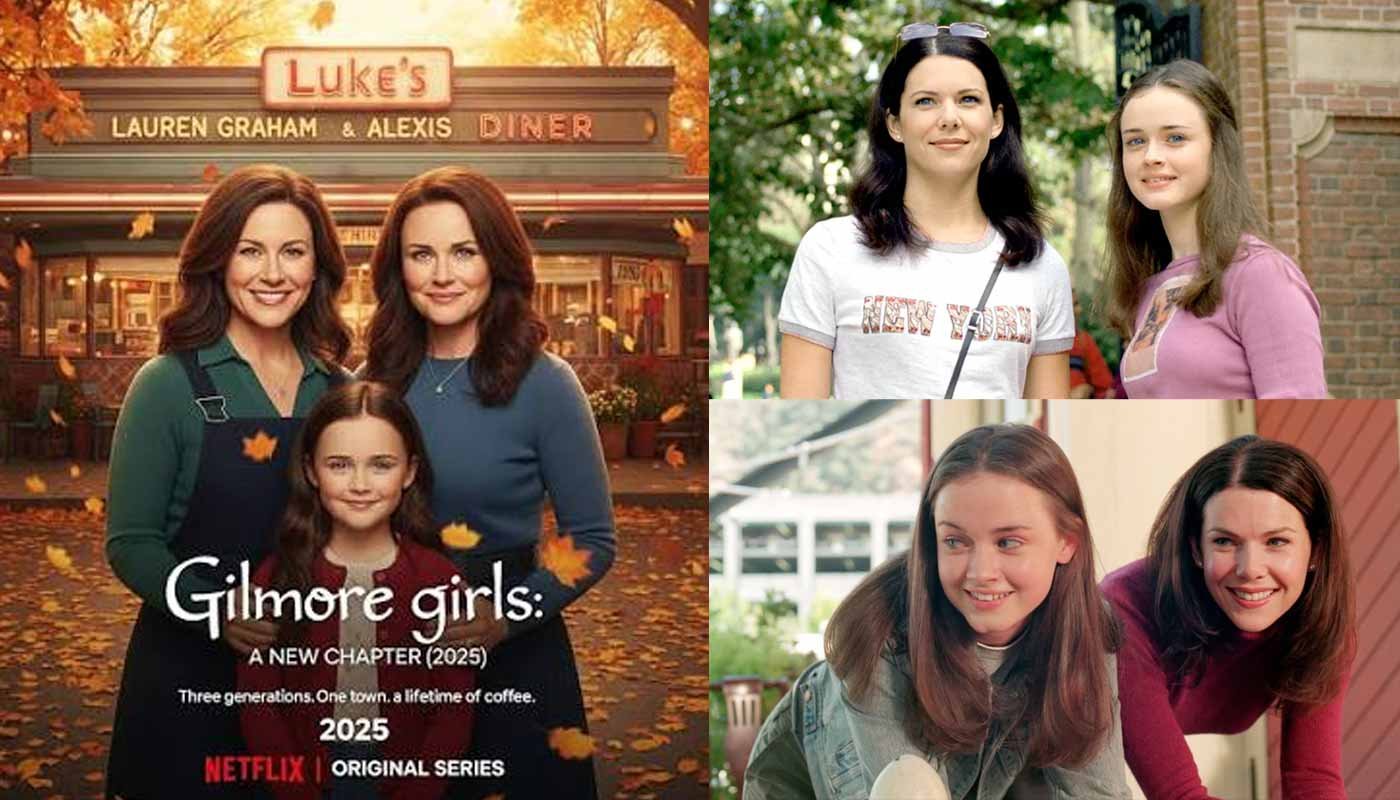
More than 25 years after Lorelai and Rory Gilmore first walked into Luke’s Diner, Stars Hollow is once again having a moment.
The trigger this time is not a new season, despite the hopes and speculation that inevitably accompany almost every Gilmore Girls announcement. HBO Max has confirmed that the first authorised documentary on Gilmore Girls is in production, bringing series creator Amy Sherman-Palladino, executive producer Daniel Palladino and Lauren Graham back into the conversation around the show. The documentary will include never-before-seen outtakes, behind-the-scenes footage and script pages. A release date has not yet been announced.
And if the reaction around Gilmore Girls is any indication, fans are more than ready to return to Stars Hollow.
The announcement arrives at an interesting time. Gilmore Girls may have ended its original seven-season run in 2007, but it never really disappeared. Streaming gave the series an unusually long second life, introducing Lorelai, Rory, Luke, Emily, Paris, Lane, Jess and Logan to viewers who were either too young to watch the original broadcasts or had never encountered the show at all.
That includes a sizeable audience in India.
Gilmore Girls and the Indian connection
For Indian viewers, particularly those who discovered international television through streaming rather than satellite TV, Gilmore Girls belongs to a category of shows that became popular long after their original broadcast.
Netflix played an important role in that discovery. The original series has been available through Netflix India, while the 2016 revival Gilmore Girls: A Year in the Life also brought the characters back for viewers who had discovered them through streaming.
The depth of that attachment became particularly visible when news emerged in June 2026 that Gilmore Girls was leaving Netflix in the US. The announcement caused enough concern among Indian viewers for Indian entertainment publications to specifically address whether the series was disappearing from Netflix India too.
But India’s relationship with Gilmore Girls goes beyond access to an American television show.
There is something surprisingly familiar about the Gilmore family.
The Friday dinners. The grandparents who love deeply but also interfere enthusiastically. The constant negotiation between individual freedom and family expectation. Academic achievement as a family project. Marriage, relationships, social standing and the opinions of relatives hovering somewhere in the background.
South Asian writers have previously pointed to precisely this connection. The Juggernaut explored the show’s unlikely South Asian following and the way its intergenerational family dynamics could feel remarkably familiar to viewers raised with their own version of the “what will people say?” question.
Emily Gilmore, viewed from an Indian living room, can sometimes seem considerably less foreign than her Connecticut mansion might suggest.
Why a generation that wasn’t there in 2000 loves Gilmore Girls
There is another reason the fandom refuses to fade.
Gilmore Girls has become comfort television.
Netflix itself acknowledged the extraordinary attachment when announcing the show’s departure from its US catalogue, describing it as more than simply a television programme and raising “a cup of coffee” to everyone who had visited Stars Hollow. The announcement immediately prompted emotional responses from fans reluctant to lose their familiar rewatch.
That rewatch culture is important.
Gilmore Girls is no longer consumed only as a seven-season narrative whose ending viewers are waiting to discover. People return to particular seasons, relationships, episodes and even moods.
Autumn arrives and somebody starts Gilmore Girls again.
A bad week calls for Luke’s Diner.
A complicated mother-daughter argument sends viewers back to Lorelai and Rory.
And social media has given every new generation an opportunity to reopen arguments that should, theoretically, have been settled years ago.
Team Jess or Team Logan?
Was Dean really the perfect first boyfriend?
Was Rory’s downfall inevitable?
Was Lorelai right to leave her parents’ world?
Was Emily misunderstood?
And perhaps the most dangerous question of them all: who was actually the best Gilmore Girl?
The debates continue because younger audiences are watching the same characters through very different cultural lenses.
A show that premiered before Instagram, TikTok and smartphones is now endlessly clipped, memed, analysed and reconsidered by audiences living in an entirely different media world.
Even its problematic moments are being re-examined. A recent discussion among Gilmore Girls fans, for example, revisited the stereotypical depiction of Asian cultures in a Season 7 episode, showing how contemporary audiences continue to interrogate a series they nevertheless love.
The Rory Gilmore problem
Then there is Rory.
Few television characters have experienced quite the same internet afterlife.
The teenager once presented as the book-reading, Harvard-dreaming model student has become the subject of endless reassessment. Younger viewers encountering Gilmore Girls today frequently watch Rory differently from audiences who grew up alongside her.
Her relationships, privilege, career choices and increasingly messy decisions have become material for new conversations.
That may partly explain why A Year in the Life remains so important to the possibility of another chapter.
The 2016 Netflix revival returned to Stars Hollow nearly a decade after the original finale. Its four episodes followed Lorelai, Rory and Emily through another stage of their lives, before ending with Rory revealing that she was pregnant.
Those final moments ensured that Gilmore Girls ended with another story waiting to begin.
Is there actually a new Gilmore Girls season?
For now, the answer is no.
There has been no official announcement of Gilmore Girls Season 9 or a second instalment of A Year in the Life.
What has been confirmed is significant enough to explain the renewed excitement.
The HBO Max documentary is currently in production and is being positioned as the first authorised documentary about the series. It will explore how Gilmore Girls grew beyond expectations into what Warner Bros. describes as a cross-generational phenomenon.
Lauren Graham and Amy Sherman-Palladino are also collaborating on a Gilmore Girls book expected in 2027, another indication of how much cultural life remains in a series that technically ended almost two decades ago.
The documentary should therefore not be mistaken for confirmation of another fictional return to Stars Hollow.
But it demonstrates something perhaps equally interesting.
There is still an audience waiting.
Why Stars Hollow refuses to disappear
Gilmore Girls survived the era in which it was made because its central preoccupations were never really about 2000s America.
They were about mothers and daughters.
About becoming an adult without quite knowing what adulthood is supposed to look like.
About parents whose love occasionally arrives disguised as interference.
About ambition, disappointment, friendship, first love and family expectations.
For Indian audiences, many of those themes travel remarkably well.
Stars Hollow itself adds the fantasy: a town where everybody knows everybody, festivals happen with suspicious regularity, the local diner owner remembers your coffee order and the entire community somehow has time to become involved in your personal life.
Come to think of it, perhaps that last part isn’t particularly foreign to Indians either.
Twenty-five years later, Gilmore Girls is once again generating headlines without actually announcing another season.
And that may be the clearest measure of its fandom.
The show doesn’t necessarily need to return for viewers to return to it.
But if Lorelai were to walk into Luke’s Diner tomorrow, ask for coffee and start talking at 150 words a minute, millions of fans around the world would probably know exactly where they left off.
Indian fans included.