
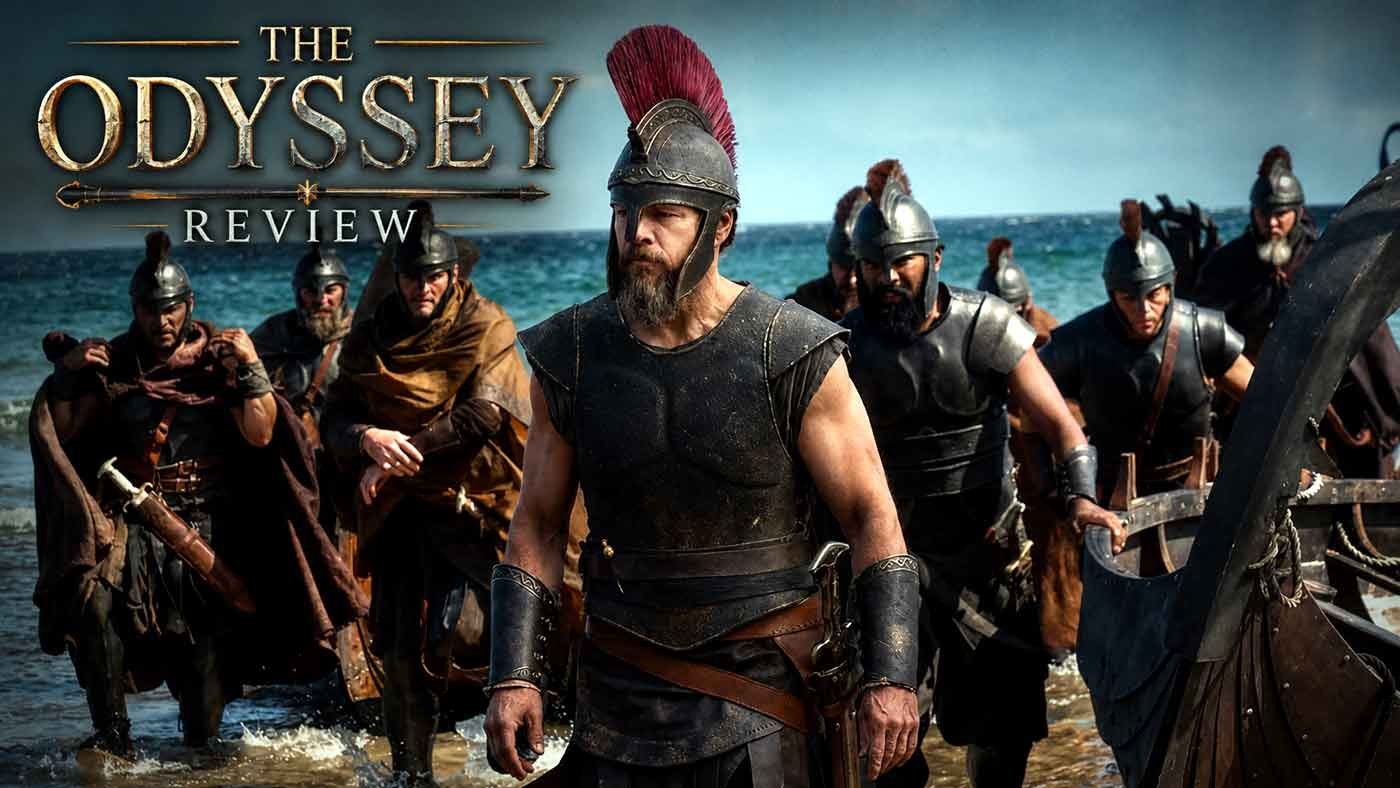
Can a story written nearly three millennia ago still speak to modern audiences? Christopher Nolan’s The Odyssey answers that with remarkable conviction. Adapting Homer’s timeless Greek epic with emotional restraint and visual grandeur, Nolan explores not just the hero’s legendary journey home, but the enduring human cost of war, loss and redemption.
The Odyssey Review By Rajeshwari Kalyanam
Christopher Nolan’s much-anticipated film is the cinematic adaptation of The Odyssey – the centuries-old Greek epic that follows the arduous journey of Odysseus, the hero of the Trojan War, as he fights the Gods, the forces of nature, the sorceress, the magic that keeps him in captivity for years, his men, and his own thoughts as he suffers through his pain and guilt for 10 years before the homecoming to meet his wife, Penelope.
Here was a character already etched in all his heroics and faults in the pages of an extremely popular epic. By the way, the author was Homer, who wrote the poem in 24 parts, known as Books. These were written much later, while the stories that were passed on from one generation to another as an oral tradition were told in the form of songs and had been there in popular culture from much before.
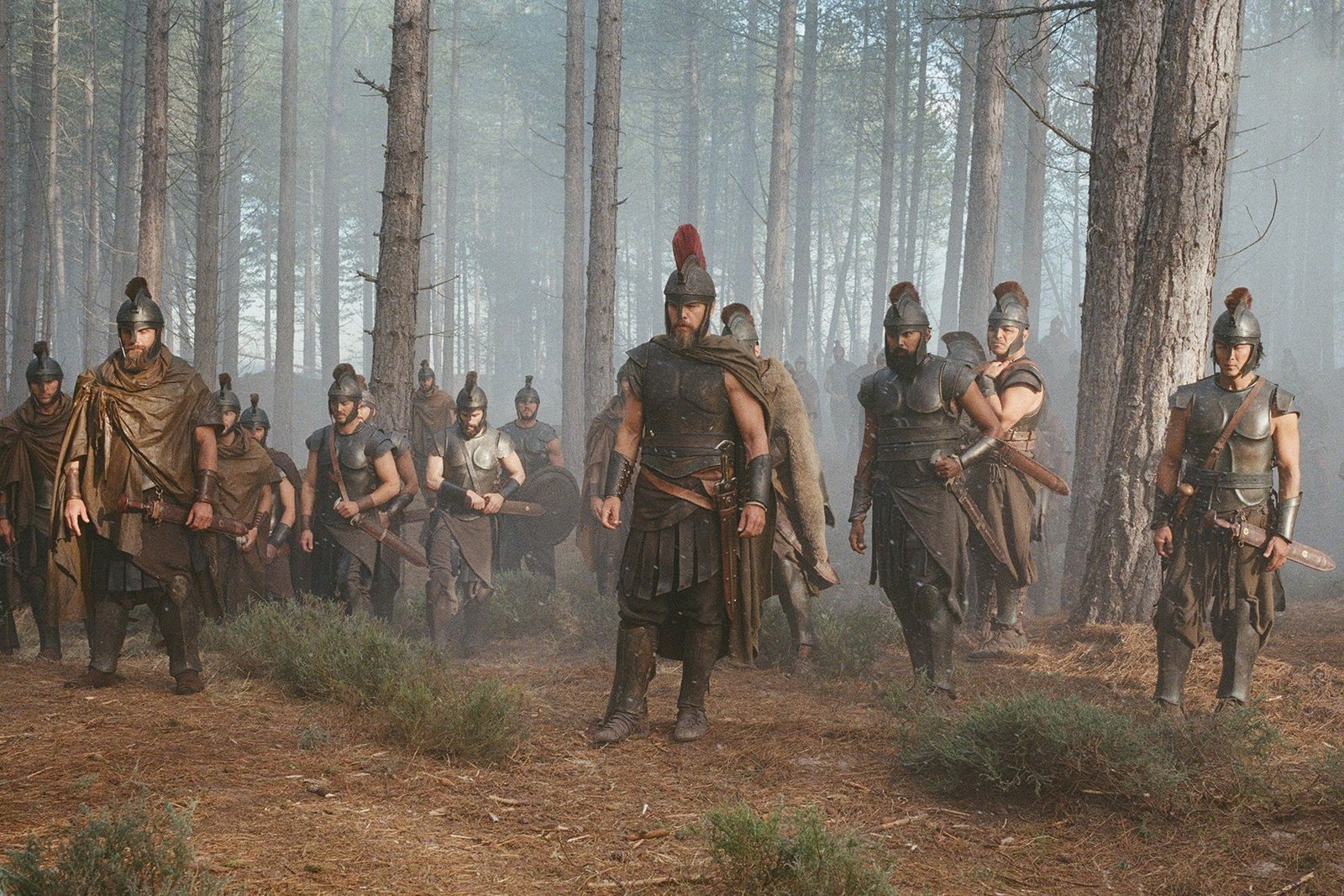
The timelessness of The Odyssey can be attributed to the various elements that it represents which are translated visually in the film: faith, trust, law of the land, wrath of nature, loyalty, deceit and, most importantly, the futility of war and the destruction it leaves behind, irreversibly so. The youth that is lost, the life that is wasted. The women of the epic – Penelope, who may be the queen for over eight years but is still not considered for the crown for being a woman, and Helen. She is famously known as the face that launched a thousand ships, and is projected as the reason for a war; but as she mentions – ‘wars were and are ever waged in service to the greed of kings.’
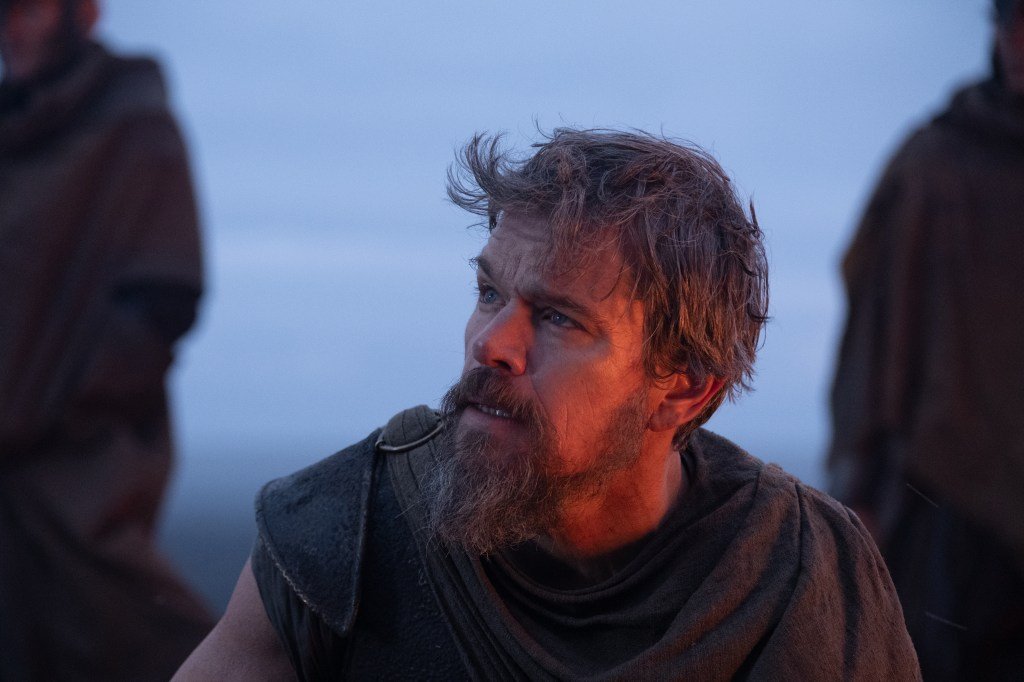
And, Christopher Nolan’s casting of Matt Damon as Odysseus, Tom Holland as Telemachus, Anne Hathaway as Penelope, Robert Pattinson as Antinous, Lupita Nyong’o as Helen, Zendaya as Athena and the supporting cast, including Elliot Page, Benny Safdie and Himesh Patel, fit into the screenwriting that focuses on the emotions and the story. It feels like the director intentionally stayed away from dramatisation or blood and gore – this ensured there is relatability and connection with no distraction. Nolan makes his characters speak the dialogues that carry the story forward, introducing the many characters seamlessly as it goes along, and slipping in an expression here and a metaphor there, to drive home his point. It felt like Nolan consciously restrains himself, especially during war scenes where men plunder and kill indiscriminately. It’s almost as if he did not want to glorify the war and bloodshed. One felt this also led to underwhelming of a few scenes that could have been otherwise spectacular. That said the picturisation was on the whole phenomenal.
Like the rest of Nolan’s films, The Odyssey is technically brilliant. Special mention needs to be made of the musical score by Ludwig Göransson, which adds an important layer to the screenplay. The war scenes involving the Trojan Horse, where he uses the drums in crescendo, are brilliant.
Homer’s storytelling, like Christopher Nolan’s, was non-linear. It begins in Ithaca, where Odysseus’ wife Penelope is waiting for her husband in all faith. And, their son Telemachus is troubled by her suitors who overstay their hospitality, feasting on their food and wine while waiting for Penelope to choose one of them as her husband. He hopes to find news of his father. It has been eight years since the war of Troy. And, many begin to lose hope except for Odysseus’ swineherd Eumaeus and his dog.
Odysseus, on the other hand, sets sail on his ship with his crew. However, along the way he blinds the monster, who is the son of Poseidon, the Sea God. And, when during their journey the ship is hit by rain and wind, the crew fears it is the wrath of the Sea God in action. This part of the story is told in his voice. What follows and how Odysseus manages to reach his wife, reunites with her, kills the suitors, punishing them, is what the rest of the story is all about.
Christopher Nolan’s win on The Odyssey is the way in which he kept the epic humane. He has gone to lengths to keep the storytelling as authentic as possible by not resorting to larger-than-life sets and using real locations to shoot his scenes. He uses The Odyssey – a centuries-old story – to tell the story of our times, where the law of God, his message of love are disregarded, and the world is at war leading to destruction and loss of life with no thought towards the aftermath.
As Zeus says – Humans bring consequences upon themselves through their own reckless choices – and Odysseus is just not an ideal hero that we see in our stories, and perhaps other Nolan films – he is a representation of this truth that actions have consequences. He makes mistakes, suffers in guilt and sets out to redeem himself.
The Odyssey Review
Rating – 3.5 / 5.0